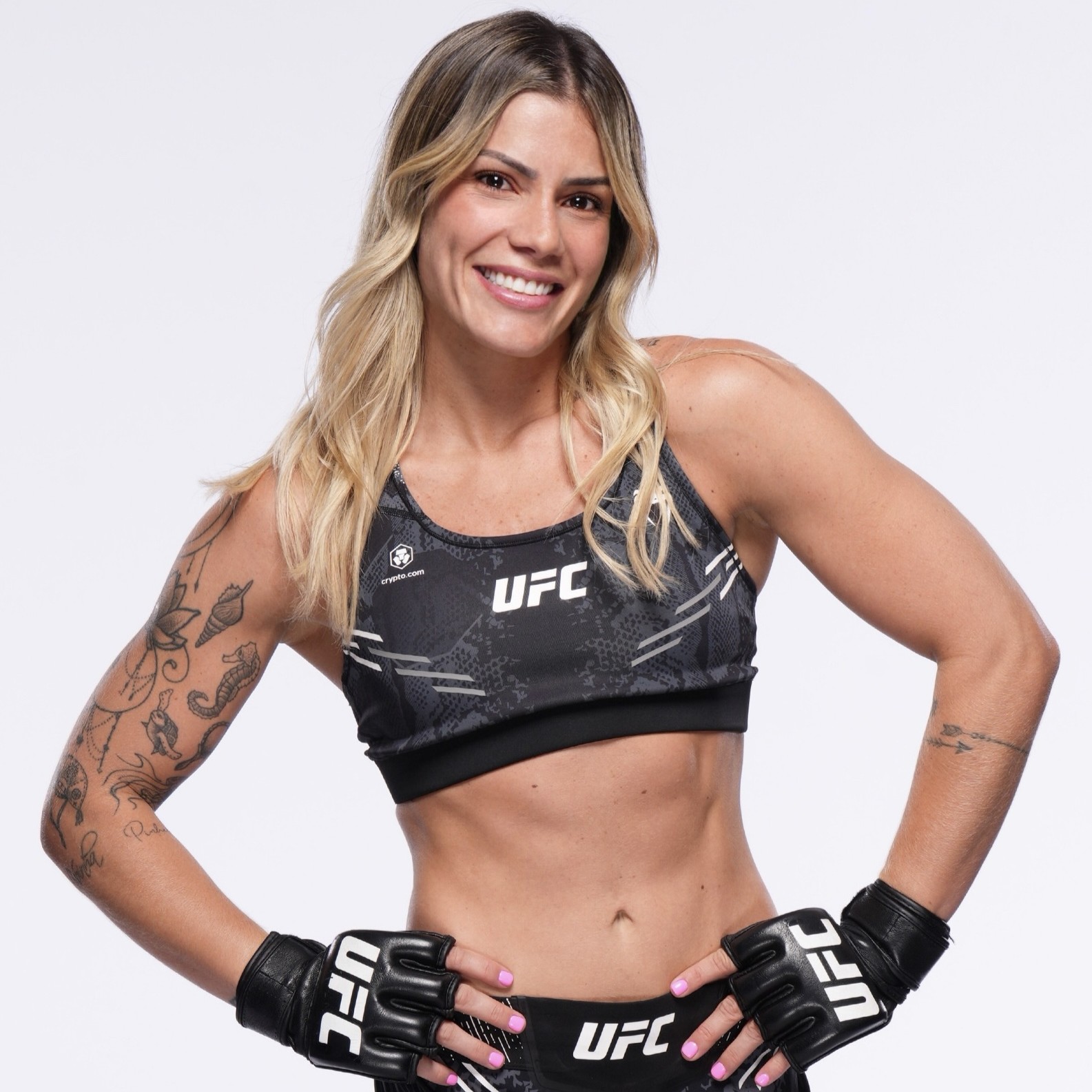

Luana Pinheiro is a Brazilian professional MMA fighter from João Pessoa, Paraíba, Brazil. She started practicing judo when she was just two years old, influenced by her father, and spent her entire athletic career in judo before making the transition to MMA. After watching Ronda Rousey compete, Luana Pinheiro became curious about MMA and decided to give it a try. She began training MMA and gradually added Brazilian Jiu-Jitsu, striking, and other disciplines to her game. She turned professional in 2016 and has competed internationally, including for BRAVE Combat Federation and the Ultimate Fighting Championship. Her journey from a lifelong judoka to a UFC fighter has been built on discipline, hard work, and a willingness to keep learning and challenging herself.
Hi Luana Pinheiro! Tell us about who you are and where you are from.
Hi! I’m Luana Pinheiro, a professional MMA fighter from João Pessoa, Paraíba, Brazil.
I started judo when I was two years old, so martial arts have literally been part of my life for as long as I can remember. My dad was the person who introduced me to judo, and I ended up spending my whole athletic career in judo before making the transition to MMA.
I think a lot of who I am today comes from that background. Judo taught me discipline, how to compete, how to deal with losing, and, probably most importantly, how to get back up and keep going.

How did you get started in mixed martial arts, and how long have you been fighting?
My story with MMA actually started when I began watching Ronda Rousey fight. Seeing a woman with a judo background doing so well in MMA really caught my attention. I remember thinking that maybe I could try it too.
Before MMA, I had only trained and competed in judo. I didn’t grow up doing Jiu-Jitsu or striking. I started learning those things after I decided to train MMA, and it was definitely a new experience for me.
I turned professional in 2016, so I’ve been competing professionally for around ten years now. It’s crazy to think about how much has happened since I first decided to give MMA a chance.

What led you to choose this career? What makes your story unique?
Honestly, Ronda Rousey had a big influence on that decision. I already had my whole life in judo, but watching her compete in MMA made me realize that maybe my judo could take me somewhere else.
What makes my story different is that I came into MMA as a judoka. Judo was all I knew before MMA. So when I started, I had to learn a lot of things from the beginning, Jiu-Jitsu, striking, wrestling, and especially how to put everything together.
I’m still learning today. I think that’s one of the things that I love about MMA: there’s always something new to work on.
How was the transition from amateur to professional?
Honestly, I never really had a transition from amateur to professional because I never fought amateur in MMA. My first MMA fight was already as a professional.
Before MMA, my whole life was judo. I started very young, so competing was something I was already used to. But when I started MMA, I was learning so many new things at the same time. I started training MMA after watching Ronda Rousey, and I remember thinking, “I want to do this.” 😂
My judo gave me a really good foundation, especially mentally, but I still had to learn striking, wrestling, Jiu-Jitsu, and how to put everything together for MMA.
Making my professional debut was definitely a big moment for me. I was stepping into something completely new, but at the same time, competing wasn’t new to me. I think that helped me a lot. I just had to trust what I had learned, keep improving, and figure out who I was as an MMA fighter.

When was your first professional fight?
My first professional MMA fight was in 2016, about six months after I started training MMA. So, honestly, it was kind of crazy. 😂
I had this idea in my head that my first fight was going to be just like Ronda Rousey — I was going to take the girl down and submit her really quickly. That was literally what I thought was going to happen…at least in my head. 😂
But then the fight happened, and it was three rounds of absolute war and craziness. 🤣 It was definitely not what I imagined, but it was such an important experience for me.
I was still very new to MMA and had so much to learn, but that fight made me realize how different MMA really was and how much I still had to develop. Looking back, I’m really glad that I took that step so early because it started a whole new chapter of my life.
How many fights have you competed in so far?
I’ve had 16 professional MMA fights so far.
When I think about that number, I realize how many different experiences are behind it. There have been amazing moments, difficult moments, wins, losses, injuries, and a lot of learning.
Every fight has given me something, even the ones that didn’t go the way I wanted.

How would you describe the differences and similarities between BRAVE Combat Federation and the Ultimate Fighting Championship?
BRAVE CF was a really important part of my career. It gave me the opportunity to fight internationally and helped me grow a lot as a professional fighter.
The UFC is obviously a much bigger platform, and the level of exposure and competition is incredible. You know that every time you step into the cage, you’re facing someone who has worked their whole life to be there too.
But at the end of the day, I think the biggest similarity is that once the cage closes, it’s still just you and your opponent. All the lights, the organization, the crowd, it doesn’t matter anymore. You still have to fight.
How do you usually prepare for a fight, and how long do your fight camps normally last?
I’m pretty much always training, so I don’t feel like I completely turn training on and off depending on whether I have a fight.
Once I have an opponent, though, everything becomes more specific. We study the opponent, work on the strategy, and focus more on the areas that I need for that particular fight.
A normal camp for me is around eight to ten weeks, but it can vary.
I also think the mental side is huge. You can be physically prepared, but if your mind isn’t ready, it’s going to be difficult to perform the way that you want to.
What is the post-fight recovery process like?
After a fight, the first thing is listening to my body. MMA is hard on you, and sometimes you don’t realize how much until the fight is over.
I take time to recover physically, work with my team and physical therapists, and deal with anything that needs attention before going back to full training.
I’ve also learned that recovery isn’t just physical. After spending weeks completely focused on one fight, you need some time mentally too. Sometimes you just need to breathe, disconnect a little, and enjoy life outside the gym.
What are some of your most memorable fights?
My fights in BRAVE are definitely very memorable because that was such an important stage in my career. Fighting internationally and getting that experience meant a lot to me.
And obviously, my UFC fights are very special because getting to the UFC was something I dreamed about when I started MMA.
But honestly, some of my most memorable fights are the ones that challenged me the most. Sometimes a fight doesn’t go the way you want, but you learn more about yourself from those moments than you do from an easy win.
Those experiences have helped me grow a lot.

What aspects of MMA do you find most rewarding and challenging?
I love that MMA never lets you feel like you know everything. There is always something you can improve. Even after all these years, I still feel like a student.
The most rewarding part for me is seeing that improvement and knowing that all the hard work is actually changing me as a fighter.
The hardest part is probably the uncertainty. You can train for two or three months for one night, and then anything can happen once you’re in the cage.
You have to learn how to deal with pressure, injuries, wins, losses, and all the emotions that come with the sport. It’s not always easy, but I think that’s also what makes it so addictive.
Do you have any role models who have guided your journey?
Honestly, I’ve had a lot of people who have played a big part in my journey, and it’s hard to choose just one.
My father will always be one of the most important people in my life. He was the one who put me in judo when I was very young, and I don’t think either of us could have imagined where that decision would take me. Judo became my whole life, and so much of who I am today came from that.
Then there’s Ronda Rousey. 😂 Watching her fight was actually what made me start training MMA. I remember watching her and thinking, “I want to do that.” I had no idea at the time how much that decision was going to change my life.
My first MMA coach, Cristiano “Titi” Lazarini, was also very special to me. He was the first person in MMA who really embraced me and believed in me when I was just starting out in Belo Horizonte. I was new to MMA, but he saw something in me and gave me the confidence to believe that I could actually do it.
Later, I trained at Nova União in Rio with André Pederneiras, “Dedé,” and I learned so much from him. That was another really important chapter for me as a fighter.
And, of course, my husband, Matheus Nicolau. He has been a huge part of my journey. I’ve learned so much from him, and I’m still learning from him every day. Having someone by your side who understands the life of a fighter on such a deep level is really special.
And now I’m in a new chapter here in California, training at Team Oyama with Colin Oyama. He has become an important part of my journey and continues to help me grow as a fighter.
So, I guess my role models have changed throughout my life, but each person has left something with me. When I look back, I can see pieces of all of them in the fighter and the person I’ve become.

What advice do you have for people with similar aspirations?
Don’t give up just because things aren’t happening as quickly as you want them to.
There are going to be difficult moments. You’re going to lose. You’re going to get frustrated. You might even wonder if you’re good enough.
I’ve had those moments too.
The important thing is to keep showing up and keep learning. You don’t have to have everything figured out right away. Just try to be a little better than you were yesterday.
And enjoy the process, because it goes by faster than you think.
Any upcoming fights or other ventures that we should currently be looking out for?
Right now, I’m focused on getting healthy, continuing my recovery, and getting myself ready for the next opportunity.
I don’t have a confirmed fight date that I can announce right now, but I’m working toward getting back in the cage and continuing my journey in the UFC.
I want to make sure that I’m ready when that opportunity comes. I’d rather take the time to come back healthy and prepared than rush the process.
Where can we follow you on social media?
You can follow me on Instagram at @luanapinheiromma.
I share pretty much everything there — my training, fights, travels, and also a lot of things from my life outside of fighting. I’m not just an MMA fighter, so I like showing the other sides of me too. Sometimes it’s training, sometimes it’s traveling, photography, food, random things that I’m doing…honestly, a little bit of everything. 😂
Before you go, let’s ask you a couple of off-topic questions:
What would you be doing if you weren’t an MMA fighter?
Oh my God, I think this is probably one of the hardest questions for me because I have so many things that I want to do. 😂
I was a very hyperactive kid. I was always doing something — I did swimming, gymnastics, handball, ballet, futsal…I just couldn’t sit still. 😂 So, I think that part of me would still be the same.
I love drawing, I’m a photographer in my spare time, I love fashion, and I really love teaching martial arts to kids. I also love playing guitar and singing.
And there are so many things that I still want to learn. I would love to learn how to surf and play the piano. I have a huge list of things in my head that I want to try, but there’s never enough time.
So if I wasn’t an MMA fighter, I honestly don’t know exactly what I would be doing. Probably a little bit of everything. 😂 I just wish my day had more than 24 hours!
I think that’s always been a big part of my personality. I get excited about learning new things, and I don’t like feeling like I’m stuck doing just one thing. Fighting is a huge part of my life, but there are so many other things that make me who I am too.
What is something that people might be surprised to learn about you?
Maybe that I’m actually a very curious person and I get bored really easily. 😂
People probably look at me and think my whole life is MMA — training, fighting, eating, recovering, repeat. And honestly, it is a big part of my life. But I have so many other interests that sometimes I wish I had three lives to do everything that I want to do. 😂
I love photography, drawing, fashion, music…I play guitar, I like to sing, and I’m always wanting to learn something new. Right now, I still want to learn how to surf and play the piano. My list never ends. 😂
I think I’ve always been like that. I was a very hyperactive kid and I tried so many different things — swimming, gymnastics, handball, ballet, futsal. I was always looking for something new to do.
So, I guess what might surprise people is that I’m not really the serious, intense fighter they see in the cage all the time. Outside of fighting, I’m actually pretty goofy, curious, creative, and I love doing simple things and having fun.
MMA is a huge part of my life, but there’s a whole other person outside the cage. 😂
Thank you for the great interview; wish you much continued success!