
With “Oh, What a World” out now, we took some time to hear from Rusty Reid. Read below to learn more about Rusty Reid, the story behind “Oh, What a World,” and what’s to come.
Hi Rusty Reid! Let’s start with how did you choose your stage name?
Hi there. Thank you for the interview. “Rusty” is my childhood nickname, and Reid is my middle name, after my grandmother’s maiden last name. So to the extended family, I became Rusty Reid. I always liked the alliteration involved, likening it to Roy Rogers, so I just kept it as a nom de plume and musique.
What city are you from, and where are you based now?
I was born and raised in Midland, Texas, graduated from Midland High School. After high school, I attended summer school at the University of Texas in Austin, then moved to Houston, eventually graduating from the University of Houston. These days I’m up in the Pacific Northwest near Seattle.
At what point in your life did you decide to pursue a career in music? How did you get started?
Reflecting back, I think the first inkling may have stirred when hearing the Everly Brothers on the radio and watching them on television. I would have been seven or eight years old, and was very taken with them. They were cool looking guys and sang beautifully. Later came the Beatles and that sealed the deal of “I want to do that.” There was some instrumental and singing talent in our family. I had an uncle who had been a cowboy singer on the radio in Austin back in the 1930s. Both my older male cousins were good musicians, one even in a rock band. So it wasn’t a far-fetched notion. I took piano lessons for about five years then switched to guitar. Out in West Texas we had both Buddy Holly and Roy Orbison singing and writing their own songs, so, along with the Beatles, the idea to try write songs was planted early as well. I was flat terrible at both guitar playing and songwriting for quite a long while. But somehow I kept at both, which was strange for me as I was a quitter at everything else. After three or four years, I finally wrote a few songs I liked, and that gave me “proof of concept” that I could do it. And a few other folks began to believe in me. A Midland couple that I had met through the community theater paid for my first recording session at a small studio in Odessa. After a year and a half at UH, and getting some semblance of recognition there, I decided I was ready for Nashville. Almost immediately upon arrival I was on the songwriting staff of one of the largest music publishing companies in the world, and recording demos at famed RCA Studio B where a million hits had been recorded. Alas, that phase only lasted about eight months. Folks in Nashville routinely noted that my songs seem “more L.A.” in structure. The publishing company draws dried up and I wound up working in a sheet metal shop. So I decided to go to Los Angeles and see how that might work out. There they listened to my Studio B demos and declared, “This sounds like Nashville!” After many rejections, I worked for six months at a gas station on the Ventura Freeway. Then, it was time to return to Houston to finish college and get serious about honing my songwriting skills.
How would you describe your sound?
I don’t think there’s a singular “sound” per se. I try to create soundscapes that serve each individual song, but there are common threads. My voice is a constant, though I do try to explore different moods and tones and personalities within that vocal range. Most of my songs are guitar-based, either electric or acoustic. For my electric guitar sound, I usually like an organic, natural, woody, rounded tone in general, not a lot of distortion or effects or gimmicks. I do love world music, so you might see those influences make an appearance here or there. My song, “Sat Cit Ananda,” on the Head to Heart album is a full-blown indulgence in the direction of Indian music. I also like to give my players rein to stamp the song with their style, so I think there’s a fairly wide range of “sounds” going on in my catalog.
Who are some of your main musical influences?
Definitely the aforementioned Everly Brothers, Buddy Holly, Roy Orbison, the Beatles, but also Paul Simon, John Fogerty, Tom Petty, CSNY, more recently Crowded House, U2, Lukas Nelson, Brandi Carlile, so many really old and new.
Have any songs come to you in a dream, as with songwriters like Paul McCartney and Paul Simon?
I can’t say that’s happened. But they have come to me out of the blue. In fact, during that long hiatus between NWXSW and Head to Heart albums, I was just driving down the highway and a phrase popped into my head: “Had to leave the old state to find me.” I have no idea to this day where that come from. I didn’t even know what to make of it. But it turned out to be the key that unlocked a flurry of songwriting that eventually built Head to Heart. It was about my own personal journey, as well as those of many other seekers. Turns out for true transformation, you have to leave your old “state” to discover your true potential. You have to lose yourself to find your higher self. Not many people take that route. But, it’s the true spiritual path.
Do you have any hobbies outside of music? What do you do to stay creative?
I have a flock of parrots I live with, so they keep me busy. I’ve got a large garden. I like to hike in wild places. I do a lot of reading, mostly non-fiction. I also write essays. They are available at Medium.com.
What’s one of the proudest moments of your music career so far?
I try to steer away from too much pride which can be pretty ego–driven, but certainly one of the most gratifying was the release of my second album, Head to Heart. I guess it was more of a big relief. I really thought my first album, NWXSW, released in 2001, was going to be my first and last, and I considered it something of a hodge-podge effort overall, though I think the individual songs are worthy. It took 18 years, and passing through a depression-anxiety-confidence crash-midlife crisis, whatever you want to call it, before my second album was released in 2019, with mostly newer songs and a much more coherent theme. It’s effectively a double-album and a quite novel political, philosophical, spiritual (not religious) journey insofar as a musical work. It’s basically my worldview. I call it a “revolutionary manifesto in song.” Though it sticks fairly closely to traditional folk-country-rock song structure and instrumentation, I think it’s gotta be one of the most radical call-for-change albums ever made thematically, lyrically. AI seems to agree with that notion. So, it’s my “opus,” and I’m quite happy with how that project at long last worked out, though it still needs a better mix.
What would you say are the greatest lessons that you’ve learned so far?
In general: find what you love and put the work in; don’t take yourself too seriously, but take the world seriously, through your head and your heart. This world is a wondrous thing. Fall in love with it.
Now onto “Oh, What a World.” What prompted you to make this cover song?
Throughout the process of selecting the songs for Lone Stardust (Masterworks of Texas Songwriters), I was keeping my eye open for songs from female Texas songwriters. I really wanted that perspective and personality to be represented. That’s when I stumbled on “Oh, What a World.” I hadn’t heard it before, but I recognized it as right up my alley. It’s almost a continuation of the thread of Head to Heart.
How does your version differ from Kacey Musgraves’?
Our version is not too very different from Kacey’s. It’s not a complete reimagining of the arrangement and instrumentation. The big difference is the male voice, and then I felt Kacey’s version, particularly her original release (she later released a slightly toned-down version) was a bit too gimmicky. It’s a great melody with a great message; she’s talking about “real things,” so exactly why do we need these machine-like voices barging in?
What was the inspiration behind the cover artwork for “Oh, What a World?”
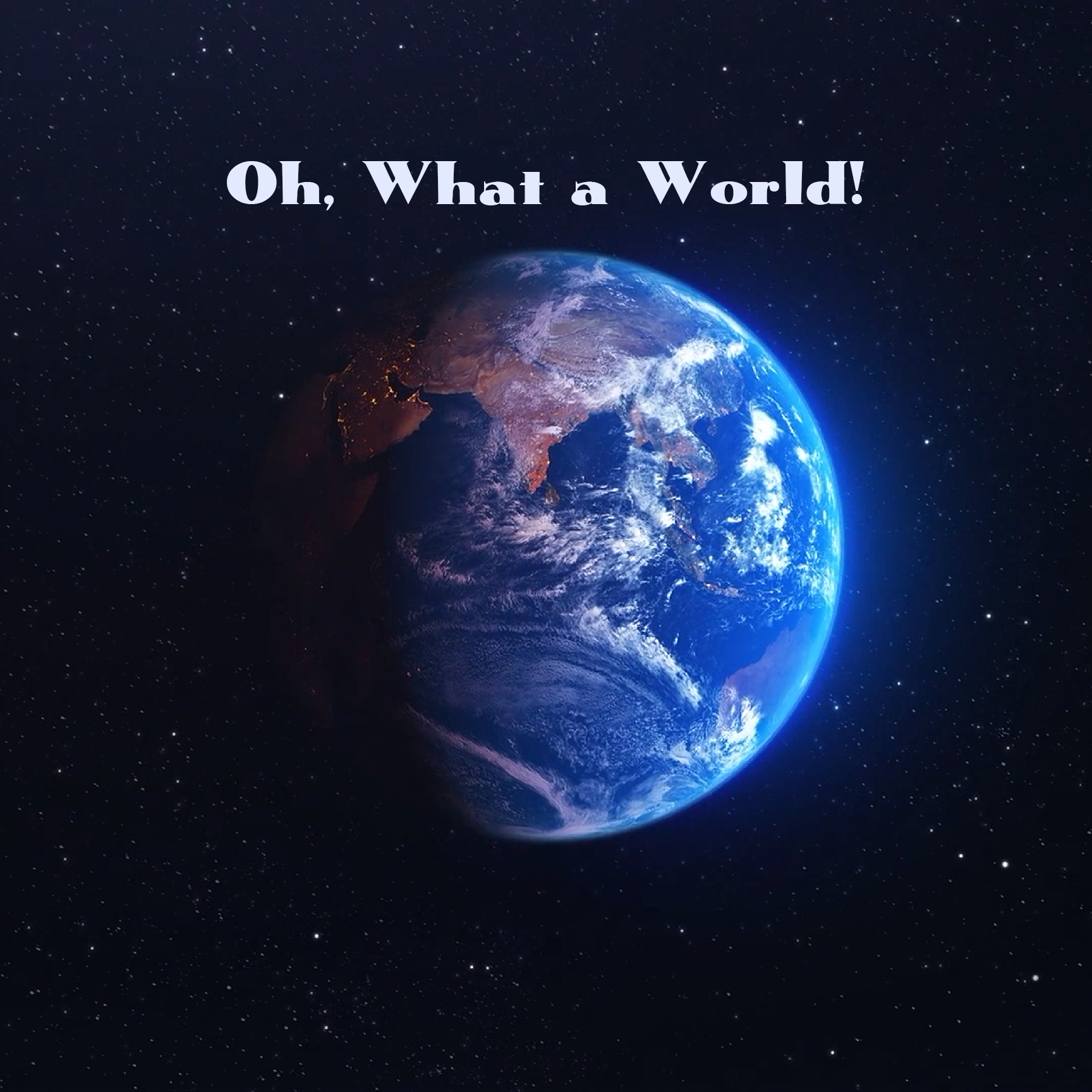
That comes from the video by Tahir Niaz, all credit to him. It’s the planet seen from space. For me, the “you” in the song is actually the world, the planet…not some person, so I felt this was the perfect image.
What was the creative process like when making “Oh, What a World?”
Jason Roller headed up the Nashville band on about half of the songs on the album. I call him the MVP of the project. For this song, I sent him my ideas and the guys just soared with it. I knew Jason would come up with some guitar licks that would be just perfect. It’s one of the few songs on Lone Stardust that I didn’t play on.
How long did it take to complete “Oh, What a World?”
Those Nashville guys work fast, so the tracks were back to me in a week or so. All I had to do was add the vocals. Thank goodness for modern technology.
What do you hope fans take away from your music?
I hope they will listen with their head and their heart. It’s a common refrain for me, as you can tell. But I think the best music should touch both the intellect and the emotions. I hope they like the original melodies I try to bring to almost every song, and the collection of words that I’ve gathered like flowers to express my own thoughts and sentiments, and maybe they will relate. I’m trying to do something original – maybe not so much with the style or genre or soundscape—but with melody and words and vocal phrasings and guitar licks. If your tastes insist on the familiar and safe and predictable, then I’m probably not your cup of tea. I’m going to challenge you to think and feel, and that takes a bit of sophistication and maturity on the part of the listener.
What’s next? Are you working on any upcoming projects, or do you have any upcoming shows that we should be on the lookout for?
Yes, I’m already working on the next album, scheduled for release next year. It’s back to newer originals with a deep theme that is in some ways a continuation of Head to Heart.
Where can we follow you on social media?
More than anyone would ever want to know is at RustyReid.com. I’m also on:
YouTube – https://www.youtube.com/@rustyreid
Facebook – https://www.facebook.com/RustyReidSongwriter
X – @RustyJunzi
Instagram – @rustyjunzi
Plus all the streaming services.
Thank you for the great interview; wish you much continued success!