
Zora Kirin writes songs that insist on hope, even when the world doesn’t make it easy. Berlin-based and classically trained on violin since age six, she calls her sound “hopecore”: narrative indie folk that finds the beauty still standing in the wreckage. Her debut EP, The Bones Are Beautiful, released on her 40th birthday. Some of its songs were carried for twenty years before finding their moment, proof that nothing worth writing has an expiration date.
With The Bones Are Beautiful out now, we took some time to hear from Zora Kirin. Read below to learn more about Zora Kirin, the story behind The Bones Are Beautiful, and what’s to come.
Hi Zora Kirin! Let’s start with how did you choose your stage name?
My true name is Veronica Zora Kirin. A mentor suggested I remove my first name, as I’m rather known in the business world (which isn’t sexy to musicians). “Zora Kirin” is my grandmother’s name. “Zora” means “dawn” in Croatian. “Kirin” is a mythical dragon found in China, Korea, and Japan who brings good luck. So, my stage name means the “dawn dragon,” which is pretty cool.
What city are you from, and where are you based now?
I grew up in Detroit, lived all over the United States, immigrated to Berlin, and am now about to move to Cologne.
At what point in your life did you decide to pursue a career in music? How did you get started?
I knew at age thirteen that I wanted to produce my music. It took until age forty to actually do it. I had too many nay-sayers around me at that young age and their voices stuck around for a while. But I was always around music: I was classically trained on violin from age six, played flute and clarinet in band, wrote my first song at thirteen, sang in Carnegie Hall at sixteen, and taught myself guitar at nineteen. Beyond that, my family is pretty musical, and so singing and folk music was always around. It’s in my bones.
How would you describe your sound?
Hopecore folk music. If you like Joni Mitchell, Phoebe Bridgers, and Regina Spektor, you’ll like my music.
Do you have any hobbies outside of music? What do you do to stay creative?
Plenty. I’m a published author under my full name, run a magazine as well, and love to read. I’ve already read 39 books this year! In downtime, I play video games, paint, macrame, or spend time in community.
Who are some of your main musical influences?
My primary musical influence is U2. You can hear it in my lyrics — that hopecore outlook. I love dynamic music and Sigur Rós provide that for me. I’m a big fan of vinyl, and have everything from old Son House albums to Radiohead and Taylor Swift. Joni Mitchell warms my soul on a cold day, and Regina Spektor reminds me I can do anything. When I was young, it was Cher and Celine Dion that taught me that female voices can be dynamic, unique, and brave — they still inspire me today.
Is there a musician that you’d like to meet?
I’d like to have a long chat over a beer with Bono. I’m an anthropologist studying paradigm shifts, specifically in technology and politics, and I think we’d have a lot of fun dissecting philosophy, politics, people, and how we find hope in the mire.
What’s one of the proudest moments of your music career so far?
Releasing my first EP on my fortieth birthday. I’m extremely proud of the performance I gave (I’ve been complimented many times for my stage presence), and I rest easy knowing that my goal of publishing at least some of my music is done.
What would you say are the greatest lessons that you’ve learned so far?
You live once, and you don’t know when it’ll end, so you’d better pursue your goals as soon as possible. I’m very lucky I lived long enough to get the cob webs out of my head.
Now onto your release, The Bones Are Beautiful. What inspired this EP?
Truly, the approach of my fortieth birthday. It’s a hell of a deadline and I knew I didn’t want to die not having put out my music. I chose from a large catalogue of songs to bring together the four that have been released.
What is the overall theme of The Bones Are Beautiful?
Hope. I’ve designed the story arch of the album to represent life — spring being wide-eyed youth, summer bringing lessons in adulting, autumn shares those lessons, and winter a love song from the grave. Even that last has hope in its center. It’s not a sad song at all.
What was the inspiration behind the cover artwork for The Bones Are Beautiful?
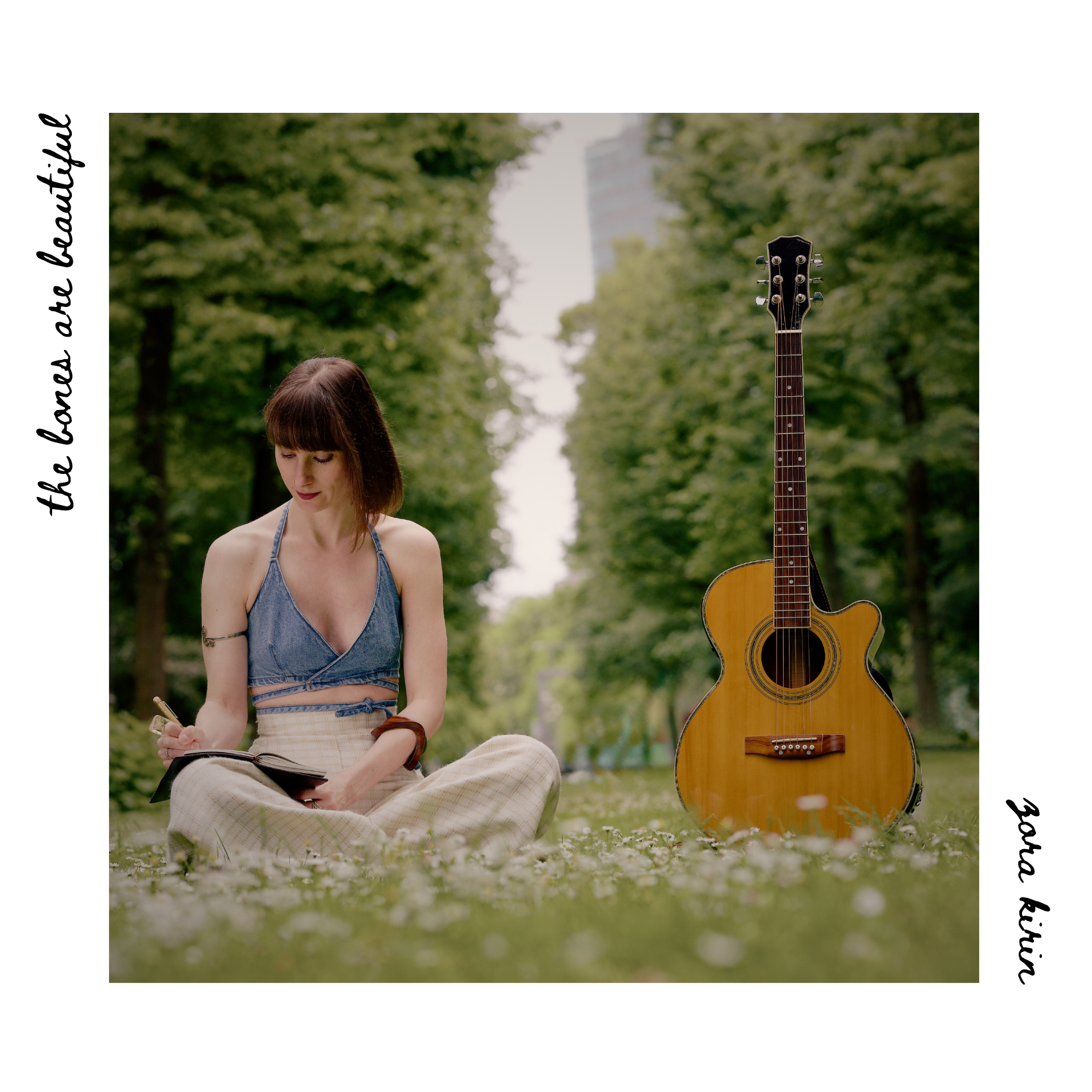
I love how The Japanese House used a white border on their first few albums. It reminded me of a polaroid, and I wanted to lean into that. Some of my songs are twenty years old, and they are written to feel timeless. The cover is intended to do the same. The cover image itself was a surprise — my photographer saw the daisies in the field and sat me in them. Now, the daisy represents the album entirely. It’s on all the promotion material and the back of the album itself. The daisy isn’t a flower much touted, but it is strong, comforting, and resilient. Just like the album’s theme.
What was the creative process like when making The Bones Are Beautiful?
The songs were already written, so it was more a matter of preparing myself. I had to get my voice back up to snuff after atrophy during the pandemic; get finger muscles and callouses back so I could play with dexterity; resume practicing violin, which is no easy instrument. I also had to set up a home recording studio and learned a lot of do’s and dont’s regarding recording. I honestly hate recording!
How long did it take to complete The Bones Are Beautiful?
I started working with a producer six months before release. It was an insane sprint and I don’t recommend compressing it so! Leave yourself a year to produce an album, even if it’s an EP.
Is there a specific song on The Bones Are Beautiful that speaks to you the most? If so, why?
I think “Step Forth” is the song that we all need. At first, it sounds like it’s speaking to young people only. But I know so many folks, my age and older, who are stuck. They let their demons gunk up the works and they end up sitting on the sidelines of their own lives. I really hope that folks listen to the lyrics of the song and take them to heart. It’s a gentle, loving kick in the ass to get out of your own way.
What message or messages do you hope fans take away from The Bones Are Beautiful and your music in general?
There is always light in the darkness. Even the worst moments have some hope, if you’ll only look for it.
What’s next? Are you working on any upcoming projects, or do you have any upcoming shows that we should be on the lookout for?
The release show was recorded, and a longer live album will be out before the holidays. I plan to gig across Europe, and hope to put out another EP in the next few years. However, I’m leaving space for the unexpected.
Where can we follow you on social media?
You can find me everywhere at @zorakirin.
https://youtube.com/@zorakirin
https://instagram.com/zorakirin
https://bsky.app/profile/zorakirin.bsky.social
Thank you for the great interview; wish you much continued success!