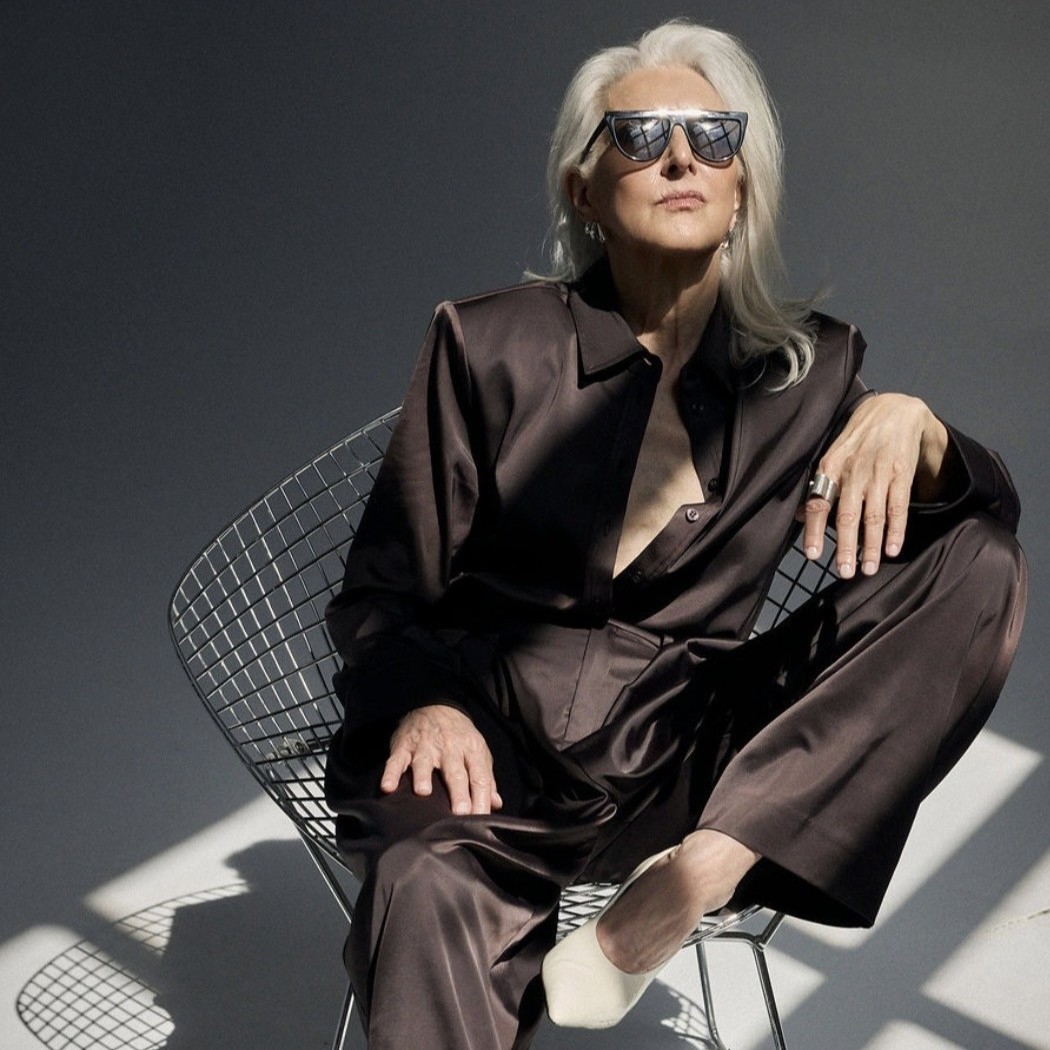

Hi Lina Vandal! Tell us about who you are and where you are from.
I am a French-Canadian painter and model, born and raised in Montreal, Quebec, where I still live. I am the mother of four children and the grandmother of six. I proudly embrace my 74 years. I take care of my body and my health not out of vanity, but because I love life. I want to have the energy to live it fully, to appreciate it, and to enjoy the things and the people I love for as long as possible.
How did you get your start as an artist, and how long have you been painting?
My father was an architect who introduced me to the visual arts at a very young age. As a child, I attended Saturday art classes at the École des Beaux-Arts de Montréal for about ten years. This gave me the opportunity to explore a wide range of techniques and disciplines while developing my skills and discovering where my interests lay.
When it came time to choose my studies and decide what I wanted to do with my life, my mother—a feminist ahead of her time—encouraged me to think about the precariousness of an artist’s career and the importance of being financially independent. I had an aptitude for and an interest in science, so I pursued a degree in nutrition, followed by an MBA in marketing. These studies led to a successful career while also allowing me to raise my family.
At 46, in 1998, the death of a close friend’s brother made me question the path I had taken. I suddenly felt an urgency to reconnect with the talent for drawing that I had neglected for so many years.
I left my job at an advertising agency and began working as a freelancer, which gave me more time and flexibility to take courses and attend life-drawing workshops at the Saidye Bronfman School of the Arts in Montreal. I was fortunate to spend six years learning from inspiring and supportive teachers who strengthened my belief that I was on the right path.
The human body and face quickly became central to my artistic practice. In 2010, a gallery discovered my work and began representing me. That same year, I rented a studio and finally committed myself fully to painting. For the first time, I allowed myself to believe that what had once seemed like an impossible dream could actually become a reality.

What led you to choose this career path? What makes your story unique?
As I mentioned above, it was only later in life that I decided to pursue and explore an impulse that had always been there, but had been somewhat dormant for many years.
My father was a wonderful draftsman, and as children we were fascinated watching him make a horse, a character, or anything else we asked for appear on paper before our eyes. He also painted in oils. I still remember the smell of oil paint and the neatly arranged rows of paint tubes.
When I was little, my parents even allowed me to paint a huge mural of Disney characters on the wall of my bedroom! I did it myself in about three days, with only a few words of advice from my father here and there.
I don’t know if my story is unique, but it undoubtedly began in a loving and supportive family environment. That is the kind of environment I wanted to create for my own children.
Did the skills that you acquired from your advertising career help with your art career?
Not in any obvious way.
At the advertising agency, I was an account supervisor. My role was to develop the most effective communication strategy based on the client’s brand and business needs, so that the creative and media teams could bring it to life through images, words and sound, and deliver it effectively to the intended audience, within the agreed timelines and budget.
Over the years, I therefore became quite familiar with the world of commercial art, without actually being the artist myself.
One of the first things that I realized when I began painting seriously was the incredible freedom of being able to create whatever I wanted. In marketing, you start with the market in order to position a brand effectively and maximize reach and, ultimately, sales. In my painting, what I want to express is the starting point—not the result of market research.
A painting may ultimately be acquired by only one person or corporation because it has moved them emotionally. The market does not dictate what I paint or want to paint. Unlike advertising, which responds to the market, my work questions it more than it responds to it.
What styles of painting do you specialize in?
My painting is a blend of figurative art and abstraction. My work seeks to portray human beings in their imperfect, mysterious and spiritual beauty, placing them in dreamlike, unreal or undefined environments that are nevertheless distinctly contemporary and often urban.
I work in series, with each series typically consisting of around a dozen paintings centered around a common theme. Working this way allows me to explore an idea from different perspectives and to let it evolve naturally from one painting to the next.
I paint raw, textured surfaces, often using trompe-l’œil effects, from which bodies and faces emerge—most often with a certain ambiguity. Ambiguity of place, gender, time and intention, leaving the viewer free to interpret the story I am presenting in their own way.
I work with acrylics, pigments, charcoal, pastels, spray paint and various forms of collage on canvas. I particularly enjoy drawing faces and bodies in charcoal.
I regularly attend life-drawing sessions to keep my sketching and drawing skills sharp. I often compare it to the way pianists practice their scales or singers do their vocal exercises.

What often inspires your art?
The dualities I see in human faces and bodies: masculine/feminine, subject/object, light/shadow, strength/fragility, inner world/environment, past/future, resistance/surrender, individuality/multiplicity.
I am fascinated by the visual diversity of large cities, which I love to explore on foot when I visit them. I am particularly drawn to neighborhoods in transition, wandering through their streets and alleyways and observing their colorful, vibrant human life.
Their infrastructures and urban signage are tattooed, scratched, sometimes fractured, bearing witness to the passage of time and of people. These constantly evolving, enigmatic environments resonate deeply with me, and I enjoy reinterpreting them in my own way.
I am also intrigued by graffiti covering walls like ever-changing, powerful paintings. I don’t necessarily see graffiti as a sign of decay. For some, I see it instead as an expression of the force of life. Although most graffiti is ephemeral, it paradoxically represents a strong desire to leave one’s mark—a healthy form of rebellion.
These environments are an endless source of inspiration for me. More recently, the rise of artificial intelligence and the entire digital universe have inspired my latest series, Fragile and AI.


How long do pieces typically take to complete?
I am often asked this question, and it is not an easy one to answer. Some paintings take months, while others are created in a matter of hours.
Some series emerge from a sense of urgency, while others need to mature in my mind for a long time before finding their way onto the canvas.
I also like to let paintings “rest” before considering them finished. Sometimes I even cover a painting I no longer like with gesso and start again, using some of the original elements as the background and starting point for a new work.
Aside from being a painter, you are also a model and an actress. How and when did you first start modeling and acting?
I am much more of a model than an actress.
I was 56 when a Montreal modeling agency discovered me at a sports club in 2008. So, modeling came into my life quite late and completely unexpectedly.
At the time, I was already wearing my natural silver-white hair. What might once have been considered a disadvantage became a distinctive asset and eventually a signature.
Back then, very few women my age dared to wear their hair naturally white. That agency was visionary, and I am grateful that they believed in my potential and helped me bring it to life.
I am happy to see that attitudes are slowly—although still far too slowly—evolving toward greater diversity in the representation of women’s bodies, whether in terms of shape, race or age.
Today, in 2026, I am represented in Canada by ANM Management and in the United States by Natural Models.
What was your first modeling gig?
It was an outdoor photoshoot in a beautiful, pastoral setting for a maternity clothing brand (Thyme Maternity, a now-defunct Canadian maternity brand). I was, of course, playing the grandmother.
The photographer was Max Abadian, whom I did not know at the time. I later learned that he was one of the most talented photographers in the industry. He was incredibly generous, and I could not have hoped for a better beginning.
What types of modeling do you specialize in, and what is your favorite type of modeling?
I don’t really specialize in one particular type of modeling. I have done a little bit of everything for a wide variety of brands, industries and markets.
My work has appeared across many different media, including television, web, magazines, newspapers, transit and outdoor advertising, catalogs, brochures and e-commerce.
My favorite type of work is fashion editorials, lifestyle advertising—as opposed to e-commerce, for example—and being the face of a brand.
I love it when a concept is bold and the photographer has a clear vision that is well expressed and communicated. It makes it easier and more interesting for the model to let go and trust the process.
I enjoy being directed while still having some latitude and freedom to actively contribute to the concept through my own creativity and sensitivity.

What do you find to be the most challenging aspect of modeling, and what do you find to be the most rewarding aspect of modeling?
One of the greatest challenges in modeling is learning to put your own image aside. Paradoxically, your image is what you are selling, but it ultimately has to serve the brand and the creative concept. The challenge is to embody that vision as authentically and effectively as possible.
There are times when you may not particularly like the clothes you are asked to wear, or the hair and makeup. As a professional, you have to put your personal preferences aside and find a way to make the intended concept work.
You also have to learn how to truly “inhabit” your body. Rather than thinking about the image your body is projecting, you need to embody the image that is being sought—to feel it and live it. At the same time, you need to know your body well and understand what it can express and bring to the image.
Being a professional painter, primarily working with the human figure, has made me particularly sensitive to creative elements such as light, curves, lines, movement and composition. I see fashion as a very special form of art. I sometimes use the expression “wearable sculpture” to describe certain garments.
That, for me, is also one of the most rewarding aspects of modeling: being part of the creative process. I have enormous respect for fashion designers, photographers, stylists, hair and makeup artists, and all the people who contribute to bringing a vision to life.
I love collaborating with them to develop and enhance a brand’s visual identity, and to see how all these creative elements come together to create something that exists beyond the individual model.
You have been in varied productions. What acting role was your favorite so far?
Acting has been a relatively small part of my experience. I have appeared in various television and web commercials and videos.
I actually prefer non-speaking roles to speaking ones. They are often closer to modeling than to acting in theater or film.
I particularly enjoyed some of the creative films and projects I have been part of that were more artistic than commercial, including a music video for Céline Dion, another for a music group, and a personal project by a well-known French Canadian director.
I remember one short film that I initially turned down, but eventually agreed to after talking with the director and gaining a much better understanding of his vision, what he expected from me and how I could contribute to the concept.
The fees in these cases are often modest and secondary. What matters most to me is being part of an interesting work with a talented and passionate team.

What are some of the most memorable moments on set?
The best moments always come from the connection, enjoyment and professionalism of the teams that I work with.
I love photoshoots because, unlike television, film or video productions, the teams are smaller and the atmosphere on set tends to be more intimate and convivial. The model and photographer work very closely together.
Over the years, I have developed affinities and preferences for certain photographers, makeup artists and stylists, and it is always a pleasure—and a certain comfort—to work with familiar people again.
That said, I also love being challenged by new teams and new ways of working.
The magical moment on set is hearing, “It’s a wrap!” and knowing that everyone is happy and satisfied with the work and the final result.
What do you find to be the similarities and differences between modeling and acting?
There is a natural connection between them: both require the ability to convey attitude and presence in front of a camera, even though the approach and the craft are quite different.
Both convey an image through the body and/or face, but an actor embodies a character by drawing more heavily on emotion.
Models are often expected to maintain a neutral, almost emotionless expression in order to keep the focus on the product. I am not entirely convinced by this approach—although I understand it for e-commerce.
Some brands want to create a sense of connection with their consumers and therefore ask models to express emotions.
An actor prepares a role, whereas a model is more often improvising in the moment, responding to the expectations and direction of the photographer or director.
I feel that, more and more, there is a crossover between fashion modeling and acting. The lines are becoming blurred. We see many actresses appearing on the covers and in the editorial pages of major fashion magazines, while quite a few actresses were first discovered as models before transitioning into film or television. In many ways, we are witnessing a blending of the two worlds.
How do you think you’re beautiful, and how do you see the future of beauty?
Beauty, to me, does not exist as an object or a subject in itself. Beauty is a relationship that gives rise to a feeling.
What makes something beautiful is the feeling it awakens, the emotion it evokes, the stimulation it creates and the experience it offers.
Beauty is ultimately a personal and subjective judgment, even though culture, society, history and the media constantly attempt to make it universal, standardized and normative.
I feel beautiful when I feel that my uniqueness is recognized and accepted as something that can inspire and enrich the people who matter to me and whom I care about.
I like to think that beauty will become increasingly multiple and plural, and increasingly less universal and normative. This vision goes hand in hand with recognizing and accepting the differences and specificities that shape our world.
To me, beauty lies in our ability to resonate with those differences.

What words of advice do you have for people with similar aspirations?
One of the advantages of getting older, at least in my own experience, is having a clearer sense of who I am, what I want, and what I have to offer. I’m happy to have discovered both modeling and painting later in life. I feel that coming to these creative pursuits with greater self-awareness and life experience has given me a sense of freedom and authenticity that I might not have had if I had started when I was younger. I’m able to embrace them on my own terms, without feeling the need to conform to other people’s expectations.
Earlier in life, I tended to be quite critical of myself. I was very sensitive and deeply aware of both my strengths and weaknesses. When I was younger, I was determined to work on my weaknesses—to the point of sometimes overlooking the extraordinary strengths I already possessed.
What I’ve come to appreciate over the years is the ability to be more compassionate toward myself, to let go of what I cannot control and, above all, to recognize and build upon my strengths.
Perhaps it takes a lifetime to truly learn to love and accept ourselves, to allow our true nature to emerge, and to fully embrace who we are.
So, if I could offer one piece of advice, it would be this: don’t wait for permission, and don’t wait until you feel completely ready. Trust what is already within you, follow what speaks to you, and give yourself the freedom to discover where it can take you.
Do you have any role models that have guided your journey?
My father, an architect, was deeply passionate about the visual arts and taught me to recognize beauty in its many forms.
My mother, through her profound lightness, contagious joy of life and capacity for wonder, helped shape the way I see the world and taught me to notice and appreciate the beauty it contains—including my own.
They both contributed to my desire to express myself through painting and modeling.
Professionally, when it comes to modeling, I find many women inspiring. I am particularly drawn to models who challenge the myth of the perfect body and dare to show themselves naturally, while exposing the industry practices and tactics that create unrealistic and unattainable standards of beauty.
As for my painting, I was greatly influenced by the work of some of my teachers at the Saidye Bronfman School of the Arts, including Jacques Clément, Sophie Jodoin and Jean-Louis Émond. I also follow several artists on Instagram whose work I admire and respect.
Any other endeavors or upcoming projects that we should currently be on the lookout for from you?
Nothing specific at the moment. I am continuing to develop both my painting and modeling work, and I am always open to interesting creative opportunities.
Where can we follow you on social media?
Instagram: @linavandal
Website: linavandal.com
Facebook: Lina Vandal
Thank you for the great interview; wish you much continued success!