
Liliya Grot is a unique artist whose work is permeated with deep reflections on the meaning of life. In her music, she transforms personal experiences into philosophical sonic canvases of the soul. Her goal is to use sound to help the listener feel a connection with eternity and inspire everyone to find their own answer to the questions: “Why am I here?” and “What is my true purpose?” Each of Liliya’s compositions is an invitation to contemplation and a search for truth, creating a space where every sound becomes a revelation resonating with the innermost depths of the human heart.
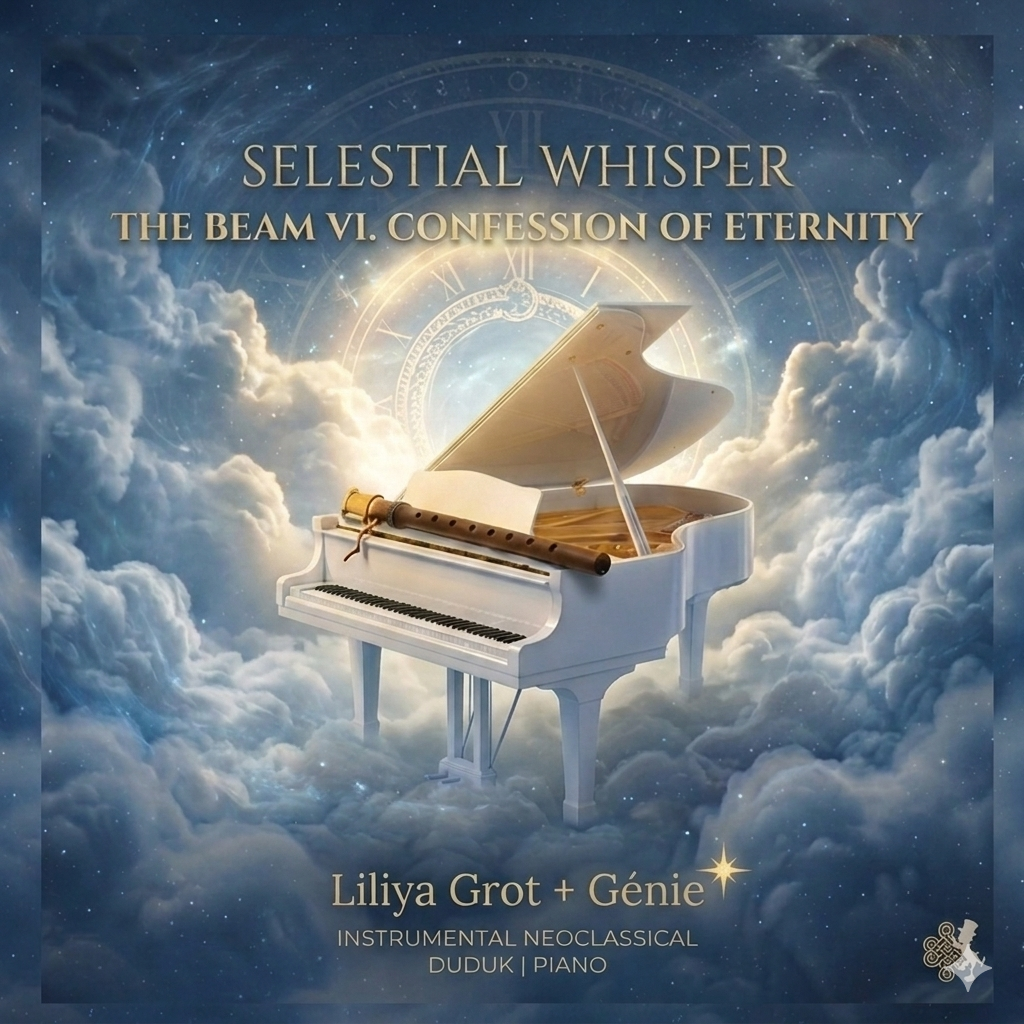
With “SELESTIAL WHISPER. THE BEAM VI. CONFESSION OF ETERNITY” out now, we took some time to hear from Liliya Grot. Read below to learn more about Liliya Grot, the story behind “SELESTIAL WHISPER. THE BEAM VI. CONFESSION OF ETERNITY,” and what’s to come.
Hi Liliya Grot! How did you choose your artist name?
Liliya is my real first name, and I chose “Grot” as my artist surname. It serves as a metaphor for a journey into the depths of one’s inner world. It represents the act of diving deep not only into the subconscious but also into the sound itself. I believe that music is the plumage of the soul, and by diving deep into the sound, we gain the ability to truly feel our soul. I am absolutely convinced that all the answers to our most pressing questions are found within ourselves, not in the external world. My name is a constant reminder that the most profound wisdom lies not on the surface, but in the quiet, inner spaces of our soul.
What city are you from, and where are you based now?
I was born in Ukraine, in the Donbas region. I have lived in France for most of my life, and my home is in Fécamp, Normandy.
At what point in your life did you decide to pursue a career in music? How did you get started?
My journey with music began very early in my childhood. I started my formal education at the age of seven, initially studying the bayan, and later I transitioned to the piano. Music became the core of my life, leading me to pursue professional studies in music schools and conservatory, where I specialized in piano and choral conducting. It was never a sudden decision, but rather a lifelong devotion to sound and art. Today, I continue to share my passion and expertise by working as a piano teacher at the conservatory in Fécamp.
What inspires you to create music?
My inspiration comes from life itself—from both its challenges and its moments of joy. When difficulties arise in my life, composing music helps me cope, process these feelings, and keep moving forward. And when I am happy, I pour that light into my sound, transforming my emotions into musical canvases. Every time I finish a piece, it feels as though I have released a white bird from within me, which brings me peace and clarity. My deepest desire is that my music might help others who are going through similar experiences, offering them a moment of calm, relief, or a space for reflection.
How would you describe your musical style?
My musical style is a personal signature that blends neoclassical and cinematic elements with deep folk influences. I often weave the soulful, ancient sound of the duduk—an instrument crafted from apricot wood and recognized by UNESCO as part of humanity’s intangible cultural heritage—into my compositions. By combining the piano and cello with traditional instruments like the kinnor (the harp of King David) and others, I create a bridge between the ancient world and modern soundscapes. It is a fusion of classical structure and the raw, timeless emotion of folk traditions, resulting in an intimate and cinematic musical narrative.
Who are some of your biggest musical influences or artists that have inspired you?
My musical foundation is deeply rooted in the great classical tradition. My education in the conservatory system allowed me to immerse myself in the precision of the Baroque era with Bach and Handel, the structured brilliance of the Viennese classics like Beethoven, and the intense emotional depth of the Romantic period, including Chopin and Rachmaninoff. I also find great inspiration in the delicate colors of Debussy and the powerful, vivid energy of Aram Khachaturian. I am deeply connected to my Ukrainian heritage, drawing inspiration from masters like Mykola Leontovych and Borys Lyatoshynsky, whose works hold a special place in my heart. In my contemporary work, I resonate with the minimalist, cinematic language of Ludovico Einaudi. Furthermore, I am profoundly inspired by the ancient, soul-stirring sounds of folk traditions, with masters like the legendary duduk player Djivan Gasparyan, whose work deeply influences how I weave ancient echoes into modern musical tapestries.
What has been the most challenging project or piece that you have worked on so far?
One of the most challenging and meaningful projects was my work as a choir master in 2025, where I led five different groups—including children’s, teenage, adult, and student choirs—and taught them to perform choral works in Ukrainian. Bridging that cultural and linguistic gap was a profound experience. However, my most personal and complex creative challenge is the album that I am currently composing, which consists of ten “rays.” I am now working on the eighth ray, which is dedicated to my mother, who passed away in Donbas. Due to the political situation, I was unable to attend her funeral, so this composition serves as a digital monument to her—my way of guiding her into eternity. While the first seven rays are already available on Spotify and YouTube, the eighth remains the most emotionally demanding project I have ever undertaken.
What is your ultimate goal or message that you hope to convey through your music?
My ultimate goal is to act as a conduit for light, channeling music as a pure energy of love that helps people find the inner strength to navigate life’s challenges. My message is simple: you are vital, and there is no one more important in this world than you. I want my music to help you feel your soul, to feel that it is eternal, and to remind you of your unity with the world around you and with nature. No matter how dark the moment may seem, it is only temporary. Just as the dawn always follows the night, I want my music to remind you that difficulties are fleeting and that there is always hope for the better. In the end, I want my listeners to believe in themselves, remember that they possess the inner power to overcome anything, and become happy in their own unique way.
How do you prepare yourself before a performance or a recording session?
My preparation is a way to dive deep into myself. I find balance in moments of solitude, especially at the lighthouse in Fécamp. Watching the wild, powerful waves of the English Channel helps me feel the pulse that I later transform into music, into my compositions. I find peace in the simplicity of nature: I love walking through the park and walking barefoot on the grass to feel the strength of the earth through my feet. I also love to sit on a bench on warm evenings, listening to the crickets and the seagulls with my eyes closed. Lighting a candle is another way I center myself. These moments allow me to quiet my mind, to admire the beauty of this world, and to return to my essence—feeling like a particle of the grand, living flow of the universe, where every particle is important.
What has been the most challenging part of your musical journey so far, and how did you overcome it?
The most challenging part of my journey has been overcoming self-doubt. For a long time, I was hesitant to share my music and afraid to express myself in this world, fearing that I wouldn’t be interesting to anyone because my style is quite unique and personal. There was also the daily discipline—the constant practice and technical exercises that are sometimes difficult to commit to, just like for any musician. But everything changed after my mother, Lida from Donbass, passed away. That moment made me realize how fleeting life is and gave me the strength to stop hiding. I understood that my music needs to be shared. I realized that my purpose is to open up, regardless of doubts. As for the technical side, like learning choral parts and musical accompaniment, it is a necessary part of my work at the conservatory, which I manage through my inner discipline.
What are your dreams or plans for the future of your music?
My dream is for my music to reach as many people as possible across all continents. I believe that music is a unique language that anyone, in any corner of the world, can understand without translation. I want my music to bring moments of comfort and contemplation to everyone who listens. My goal is to create a space through sound where people can feel that they are never alone. I want my music to “embrace” and “wrap” around them, providing a safe and deep space to truly realize and feel their own self. I want it to be a connecting bond that helps them find peace and remember their own inner light.
What is your biggest dream?
My biggest dream is to travel more around the world, immersing myself in the richness of different cultures, and to let those experiences flow into the music that I create.
How long did it take to complete “SELESTIAL WHISPER. THE BEAM VI. CONFESSION OF ETERNITY?”
The birth of this piece was a very personal and emotional journey. It wasn’t born in a studio, but from a moment of raw vulnerability. I was sitting in my car, watching a singer representing France at Eurovision, and felt a sudden, sharp wave of sorrow. In that moment, watching her, I felt the contrast between my path—full of struggle, severed roots, and the need to rely solely on myself—and the life that seemed so much lighter for others. I didn’t think about the challenges she might have faced; I only felt my own intense pain. I started questioning the heavens and eternity, asking why my life was defined by such constant overcoming. Then, it began to rain. It felt as if the universe was listening and empathizing with me. I stepped out into the rain, and in that connection with nature, I began to hear the sounds of this piece. It was my true confession before the heavens, and that moment became the birth of “SELESTIAL WHISPER. THE BEAM VI. CONFESSION OF ETERNITY.”
What’s next? Are you working on any upcoming projects, or do you have any upcoming shows that we should be on the lookout for?
My main focus right now is a global project: completing my current album cycle, Celestial Whisper, which consists of ten “beams.” I am pouring all of my energy into finalizing these works. For me, the creative process is paramount—first, I need to bring this vision to life, and only once the album is complete will I begin to think about sharing it through live performances. Looking further ahead, I am already envisioning my next album, which will also consist of ten pieces and will be titled Tree of Sephirot. I see this as a continuous creative journey, and I invite everyone to stay tuned as these chapters unfold.
Where can we follow you on social media?
You can follow my musical journey and stay updated with my latest releases on the following platforms:
Spotify: https://open.spotify.com/artist/2uPZp4o1ZDNNYob076bKSK
YouTube: https://youtube.com/@liliyagrot
Facebook: https://www.facebook.com/share/1EGtmgmQDG
Instagram: https://www.instagram.com/liliya_grot
Thank you for the great interview; wish you much continued success!