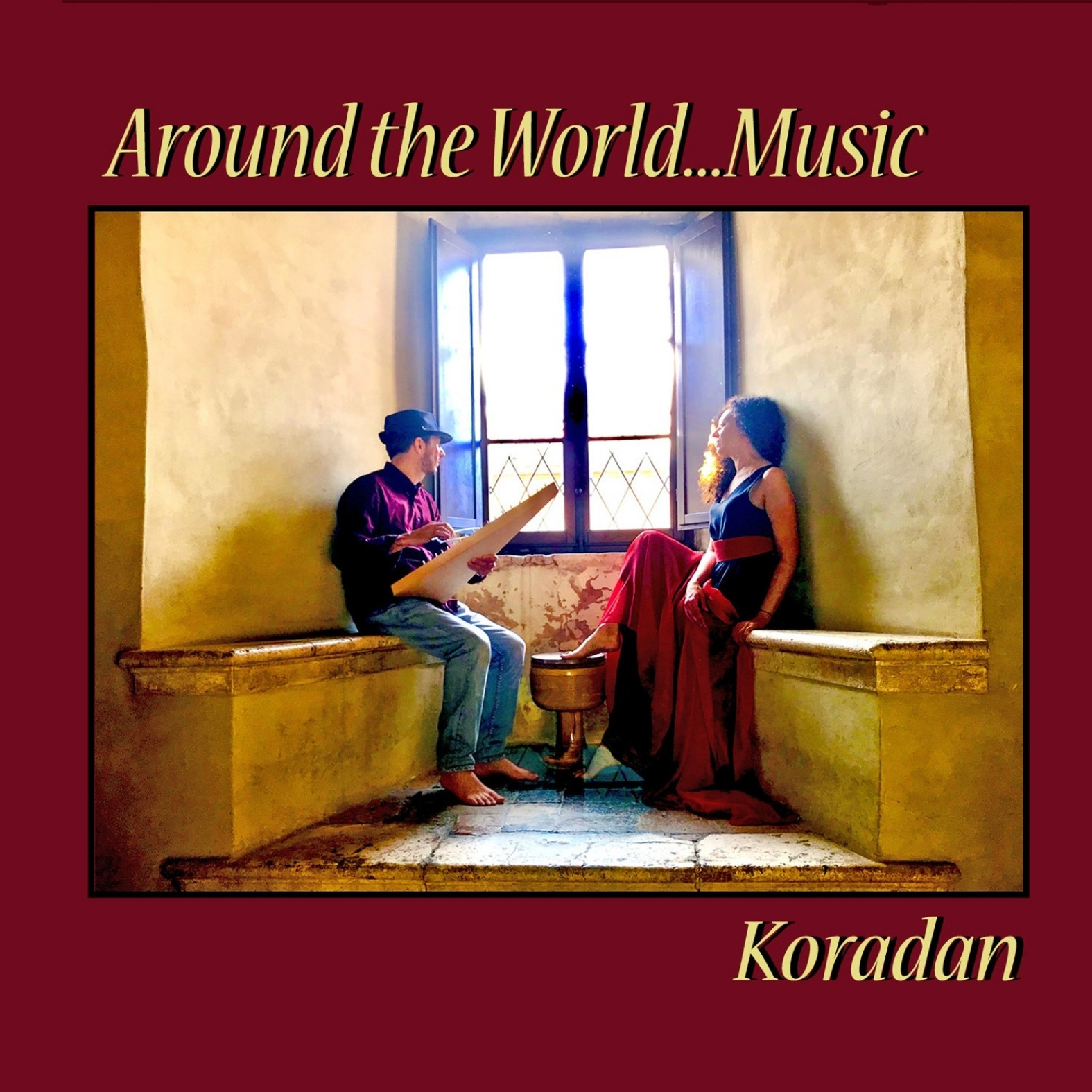

KORADAN is the artistic union of Alex Baccari and Marzia Di Cicco, brought together by a shared vision: to create music not only as artistic expression, but as a form of research, communication, and life itself.
KORADAN does not simply perform music: the duo designs and builds the very instruments they play. They recreate ancient, millennia-old instruments and, in many cases, invent entirely new ones. Among their most representative creations is the Koritas, an original, patented instrument that embodies their artistic philosophy: a single sonic body containing instruments and materials from five continents. The Koritas has become a manifesto of their intercultural vision, a symbol of dialogue between tradition and innovation—and has received international recognition, including an award from the Georgia Tech School of Music in Atlanta (USA).
Their performances are often theatrical and immersive, ranging from prestigious venues, such as Grand Theatre in the Archaeological Park of Pompeii to the raw immediacy of street performances – frequently participating in busking festivals, including a victory at the renowned Ferrara Buskers Festival.
Alongside their musical research, the group carefully curates the visual and scenographic aspects of their performances, designing and handcrafting original costumes. This attention to aesthetic detail contributes to a fully immersive experience, where sound, movement, and image coexist in a poetic and evocative balance.
At the core of KORADAN lies continuous research: from reviving forgotten instruments to experimental composition, from learning new musical languages to building dialogue between dozens of instruments from different cultures. In this constant balance between discovery, construction, and creation, KORADAN finds its true identity — a sonic bridge between cultures, eras, and sensibilities, celebrating music as a universal language that connects humanity to both its origins and its future.
With Around the World…Music out now, we took some time to hear from KORADAN. Read below to learn more about KORADAN, the story behind Around the World…Music, and what’s to come.
Hi! Let’s start with how did the group’s name come about?
The name Koradan originates from the fusion of the kora—an African string instrument—and danza (dance), with the intention of evoking and synthesizing the very soul of the project within the name itself.
What city are you both from, and where are you both based now?
Our base is Rome, a city that is not only our point of origin but also an integral part of our sonic texture. Its millennia-old layers serve as a manifesto for our blend of sounds, reflected in music made of diverse influences that overlap just like the history of the Capital.
How and when did this duo form?
The project has deep roots and has evolved through various phases until reaching the balance of the current lineup, which was born about eight years ago from a shared and consolidated vision.
How would you both describe your group’s sound?
Our sound aims to build intercultural bridges, shortening the distance between far-off lands through the meeting of their respective sounds. Our music aspires to design a world without borders—neither political nor geographical—where different cultural roots merge into a single universal language.
Who are some of your group’s main musical influences?
We are deeply influenced by ethnic music and folk traditions from all over the world. Our journey consists of constant study of original melodies and the legacy of World Music, which has taught us to respect roots while creating something new through an intercultural vision.
What’s one of the proudest moments of your group’s music career so far?
The proudest moment is the completion of this album. For years, it seemed like a utopian project, almost impossible to realize due to the complexity of the instruments and the depth of the research required. Having succeeded in bringing such an ambitious work to life after a decade-long journey is our greatest gratification today.
What would you both say are the greatest lessons that you both have learned so far?
The most important lesson is that in this world, you never stop being a student. We realized that to connect with distant cultures, you must do so with great reverence and respect, listening “on tiptoe.”
Now onto Around the World…Music. What inspired this album?
The inspiration lies in the desire to demonstrate that coexistence between distant worlds is possible. We chose “air” as the guiding element to offer the listener a flight with eyes closed over borders: a journey that crosses five continents, transforming a decade of research into a universal sensory experience.
What is the overall theme of Around the World…Music?
The central theme is interculturality experienced as a journey without borders. The album is not just a collection of songs, but a sonic manifesto celebrating the meeting of different peoples. The concept revolves around the idea of the “bridge”: music becomes the invisible thread that unites distant traditions, proving that despite differences in language and instruments, there is a common human root that can harmonize into a single, grand universal narrative.
What was the inspiration behind the cover artwork for Around the World…Music?
The cover reflects the sonic architecture of the album. The duo is seated in front of a medieval window—a threshold between the inner world of our research and the limitless universe we want to explore. It is an image of reaching toward a new horizon, recalling historical roots while looking outward
What was the creative process like when making Around the World…Music?
It was a long and meticulous job: a true “engineering of balance.” Bringing together instruments with such different physical structures and musical scales—including the complexities of microtonal systems—required a constant search for the right tonal harmony, making the meeting of distant musical grammars feel natural.
How long did it take to complete Around the World…Music?
The record is the fruit of a ten-year journey. Ten years of relentless research spent between recording sessions and studying arrangements that could honour the various traditions involved. We chose not to rush: every track needed time to layer itself.
Is it true that you all personally built and played close to eighty different instruments on the album?
Yes, it’s absolutely true. We wanted to evoke the famous Around the World in 80 Days by playing on the concept—in a way—with “Around the World in 80 Instruments,” which, in reality, adds up to even more than eighty.
One aspect we are particularly proud of is that about a third of these instruments were born directly in our workshop: we didn’t just search for them around the world, but designed and handcrafted them ourselves, to achieve the exact sounds we had in mind. Each track is a sonic ecosystem where dozens of different timbres coexist; it was a titanic challenge, but it was the only way to capture the authenticity and richness of the cultures we wanted to honour throughout this decade-long journey.
Is there a specific song on Around the World…Music that speaks to you both the most? If so, why?
Although we are attached to all of them, we have a special fondness for “Nuages.” It was the track that kickstarted the entire project. If the album is a flight, “Nuages” is the moment we lifted our feet off the ground, officially opening the curtain on this intercultural journey.
What do you both hope fans take away from Around the World…Music and your duo’s music in general?
We hope they catch the dual soul of this work: an outward exploration, but at the same time, a deep inner journey. We want them to leave with the awareness that music is a language capable of breaking down borders, reminding us that true coexistence is born from the meeting of our inner selves and the world.
What’s next? Are you all working on any upcoming projects, or do you all have any upcoming shows that we should be on the lookout for?
We want to continue taking this “flight” live, but also to strengthen our seminars and exhibitions. Our research continues in the studio as well, exploring traditions we haven’t yet delved into to give life to new chapters of this intercultural dialogue.
Where can we follow you all on social media?
You can find us on:
Our official website: www.koradan.com
Facebook: https://www.facebook.com/koradanproject
YouTube: https://www.youtube.com/@koradan_com
Instagram: https://www.instagram.com/koradan_com
Thank you all for the great interview; wish you all much continued success!