
The Lazz is a high-concept metal project led by Ben Lazzaro, a veteran composer and guitarist with over 40 years of performance experience. Lazzaro is not only a seasoned musician but a formally trained visual artist, holding an Associate of Science in Visual Communication (Honors) and bringing 13 years of professional experience as a 3D Digital Artist in the video game industry. This unique intersection of formal design theory and legacy musicianship allows The Lazz to bridge the gap between human expression and cutting-edge technology. The project explores Jungian psychological themes, Shadow and Persona, through a “Hybrid-Human” production engine that ensures every release is a high-fidelity, multi-media experience. All songs music, lyrics, and vocal melodies written, composed, arranged and mastered by Benjamin Lazzaro. Original human-performed guitar and bass tracking, integrated with a modified generative engine used for vocals, drums, effects and overall production sonics pre-mastering.
With “The Descent” out now, we took some time to hear from The Lazz. Read below to learn more about The Lazz, the story behind “The Descent,” and what’s to come.
Hi! Let’s start with how did you choose your moniker?
The name, The Lazz, came from my last name, Lazzaro. It was already something people had shortened naturally over the years, so it felt personal without being too literal. I liked that it sounded direct, memorable, and a little larger than just a solo artist name.
For me, The Lazz represents the version of myself that is finally putting all of these different creative pieces together: the guitarist, the songwriter, the visual artist, the storyteller, and the person who has been carrying some of these songs and ideas for decades. It felt like the right name because it is rooted in who I actually am, but it also gives the project its own identity and world to grow into.
What city are you from, and where are you based now?
Born in Los Angeles, California. Currently live in San Diego, California.
At what point in your life did you decide to pursue a career in music? How did you get started?
I started playing guitar when I was 13, and I’m 56 now, so music has been part of my life for more than four decades. I don’t think there was one single moment where I decided, “this is my career.” It was more that once I picked up the guitar, it became the thing I kept coming back to no matter what else was happening in my life.
I started playing in bands in high school and continued through different hard rock and metal projects for many years, covering a variety of subgenres along the way. My last period of live performance was with the band Dying Regret, where we toured and played shows around 2007–2008.
After that, life moved in different directions, but I never stopped writing. What’s happening now with The Lazz is really the result of all those years. A little over 90 days ago, I finally started publishing and bringing to life a catalog of songs I had written across decades. So in a way, this project is not a sudden beginning; it is the continuation of something I started as a teenager and never really let go of.
How would you describe your sound?
I would describe the sound of The Lazz as melodic metal and hard rock with a cinematic edge. The core is always heavy guitars, big hooks, strong melodies, and emotional intensity, but I like moving between different shades of heavy music depending on the song.
Some tracks lean more toward modern hard rock, some have a darker melodic metal feel, and others move into groove metal, metalcore, or more aggressive territory like “The Descent,” “The Blackening” and “Iron Scale.” Those 3 are my newest and most aggressive songs, not far from what I was performing while on tour with the band Dying Regret. Perhaps a bit more melodic, however.
What ties it all together is melody, atmosphere, and storytelling. I want the songs to hit with energy but also carry a deeper emotional or psychological weight. For me, The Lazz is heavy music with purpose. It is built for people who like riffs and power but also want songs that feel like they are part of a larger world.
Do you have any hobbies outside of music? What do you do to stay creative?
Honestly, music is my hobby as much as it is my creative outlet. I have a full-time day job, so The Lazz is the place where I get to step away from “real life” and put that energy into something meaningful.
For me, staying creative comes from constantly building: writing songs, shaping concepts, developing the visual world around the music, and finding new ways to bring older ideas to life. I have always been drawn to creative work, whether that is music, visual art, storytelling, or production. The Lazz gives me one place where all of those interests can come together.
So, I do not really separate music from my hobbies. It is the thing that I return to because it keeps me grounded, challenged, and creatively alive.
Who are some of your main musical influences?
My influences come from a pretty wide spectrum of heavy music. At the core, I have always been drawn to melodic metal, hard rock, power metal, metalcore, and heavier death metal elements, especially the Swedish melodic metal sound. You can hear pieces of all of that throughout the current catalog of songs I have released under The Lazz.
For the more recent material in The Alchemical War chapter, some of the current influences would be bands like Lamb of God, Arch Enemy, All That Remains, In Flames, The Raven Age, Unleash The Archers, and Killswitch Engage. That does not mean I am trying to copy any one band, but those kinds of sounds definitely live in the same musical universe: heavy riffs, melody, aggression, atmosphere, and big emotional choruses.
My original foundation goes back even further to bands like Iron Maiden, Judas Priest, Queensrÿche, Dream Theater, Scorpions, Dio, and Ozzy Osbourne. Those artists shaped the way I think about guitar, songwriting, melody, and drama in heavy music. So The Lazz is really a combination of older classic metal roots and more modern melodic metal and metalcore energy.
What would be your dream collaboration?
A dream collaboration would probably be with someone from the melodic metal or metalcore world who understands both heaviness and melody. Artists like In Flames, Trivium, Arch Enemy, Unleash The Archers, or All That Remains would all make sense in different ways because they each bring a different balance of power, emotion, and musicianship.
But honestly, I think the best collaboration would be with someone who connects with the larger vision of The Lazz: heavy music, strong hooks, cinematic atmosphere, and deeper psychological or mythic storytelling. I would love to work with musicians or vocalists who could add another dimension to that world without losing the emotional core of the songs.
What’s one of the proudest moments of your music career so far?
One of the proudest moments of my music career so far has been the sync licensing success I had with my former band, Dying Regret. We were fortunate to have songs placed in television shows and films including Blue Bloods, Criminal Minds, Banshee, The Killing, Person of Interest, Kin, Puncture Wounds, Christmas All Over Again, and the motion picture Legion with Dennis Quaid, among others.
There is something incredibly surreal about hearing your own music in a TV show or a cinematic film. When a song that you helped create becomes part of a scene, a story, or an emotional moment on screen, it gives the music a second life. That has always been one of the coolest and most validating experiences for me as a musician.
Now, with The Lazz, I feel like I am building on that same foundation, but in a much more personal and fully realized way.
What would you say are the greatest lessons that you’ve learned so far?
One of the greatest lessons I have learned is that not everyone is going to like your music, and that is completely okay. Music is one of the most subjective things in the world, just like visual art. What connects deeply with one person may not connect with another, and that does not make either reaction wrong.
That was something I had to really understand. If someone does not like a song, it does not mean the song failed. Someone else may hear that same track and absolutely love it. With The Lazz, I have realized that at this point in my life, I am creating the music first for myself. I do not publish or release anything that I would not personally listen to on repeat and enjoy every second of.
Of course, I hope the songs bring that same energy and emotion to other listeners too. But the starting point has to be honest. No matter the genre, I am always trying to write what I consider a great song. For me, that means asking: Does it create emotion? Is it composed well? Is the instrumentation and arrangement interesting? Does it make sense as a song? Is there a hook that stays with you? Is there a moment that makes you want to sing along, or head-bang because the emotion of the track hits that hard?
That has been the biggest lesson: create something you genuinely believe in, accept that not everyone will connect with it, and trust that the right listeners will.
Now onto “The Descent.” What inspired this song?
“The Descent” was inspired by the idea of katabasis, Part of Jungian Philosophy, which is the descent into the underworld, but in this case I am using it more psychologically than literally. It is about the moment where the surface identity breaks down and you are forced to confront the hidden parts of yourself.
In the larger 4 song concept of The Alchemical War, “The Descent” comes after the armor has cracked and the character can no longer hold everything together through discipline, control, or willpower. It is the point where they have to go inward and downward, into the coldest and most uncomfortable part of himself, before any real transformation can happen.
On a personal level, that idea really connects with me because I think everyone eventually faces some version of that. You reach a point where pretending, resisting, or trying to keep the mask in place stops working. The only way forward is to go deeper and face what is actually there.
So the song is dark and heavy, but it is not hopeless. To me, “The Descent” is about surrendering to that inner confrontation so something more honest can emerge from it.
What was the inspiration behind the cover artwork for “The Descent?”
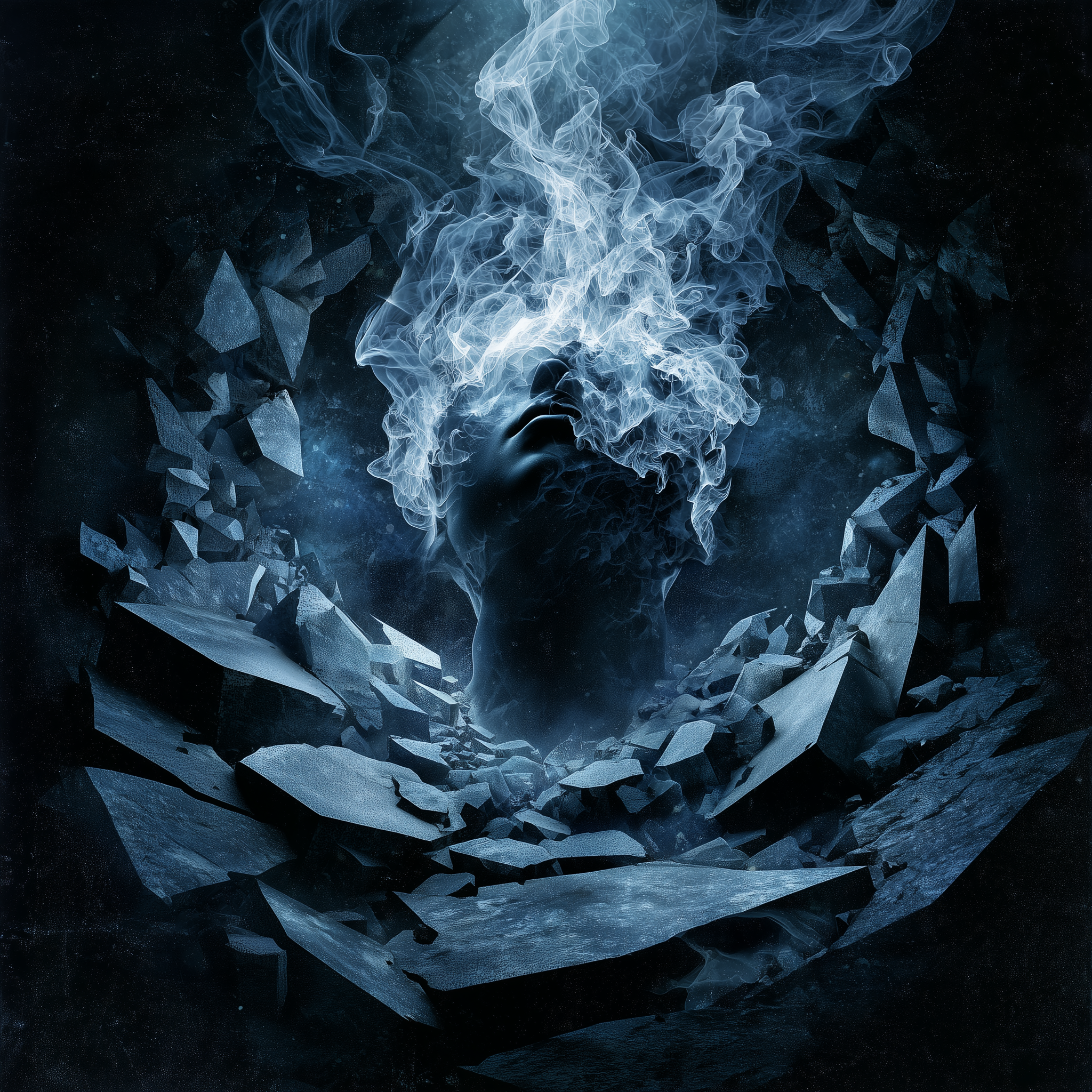
The cover artwork for “The Descent” was inspired by the same psychological idea behind the song: the moment where the self, breaks open and something hidden starts rising from underneath.
Visually, I wanted it to feel cold, fractured, and otherworldly. The shattered pieces around the figure represent the breaking of the old identity, almost like the surface of the self can no longer contain what is underneath. The blue tones give it that deep, frozen, underworld feeling, while the smoke or spirit-like energy coming from the figure suggests transformation rather than simple destruction.
To me, the image is not just someone falling into darkness. It is the moment inside the descent where the hidden self begins to emerge. That connects directly to the song’s theme of katabasis: going down into the shadow, losing the mask, and confronting the part of yourself that has been buried. It is dark, but it is also the beginning of change.
What was the creative process like when making “The Descent?”
The creative process for “The Descent” started with the concept first. I knew this song had to represent a psychological fall: the point where the character stops fighting the shadow and is forced to move deeper into it. So before anything else, I wanted the song to feel like pressure, collapse, surrender, and transformation.
From there, the music had to support that emotional arc. I wanted the track to be heavy and aggressive, but not just for the sake of being heavy. The riffs, vocal energy, and atmosphere all had to feel like someone being pulled downward into something they can no longer avoid. At the same time, I still wanted melody and structure, because for me the hook and emotional payoff are just as important as the heaviness.
The process was really about balancing those two sides: darkness and melody, aggression and meaning, chaos and control. Since “The Descent” is part of The Alchemical War chapter, it also had to connect to the larger story and lead naturally toward “Abraxas.” It is the moment before revelation, so I wanted it to feel like a breaking point, but also like the beginning of something bigger.
How long did it take to complete “The Descent?”
That is a hard one to quantify because “The Descent” goes back much further than the final recording. The original music was written in the mid-2000s and then sat for years, so I was not starting from a blank page when I brought it into The Lazz catalog.
The core song structure and composition are still the same as what I originally wrote more than 20 years ago. For this version, I re-tracked the guitars and added some new guitar textures and depth, but the arrangement itself did not need to be rebuilt from scratch. Over the years, I have become a much better player and have learned a lot about performance, writing, and production, so this version gave me the chance to bring an older song up to the level I hear it in my head now.
For “The Descent,” I did write new lyrics to fall within my conceptual series of music videos and songs. I used AI-assisted tools for the drum and vocal performances, as well as some of the overall production sonics and effects to help the guitars, drums, and vocals feel cohesive. The vocal melodies were still written by me. I originally worked them out as melodic guitar lines, then removed those guide parts from the final mix once the vocal performance was in place.
So if we are talking about the final recording and production process, I would estimate it was around 40 hours or so and that is a loose estimate. But creatively, the song has a much longer history because the foundation was written decades ago and finally brought fully to life now.
What do you hope fans take away from “The Descent” and your music in general?
With “The Descent,” I hope fans take away the idea that going into the darker parts of yourself does not have to mean defeat. Sometimes the descent is necessary. Sometimes you have to lose the mask, lose the old version of yourself, and confront what is buried underneath before you can become something more honest.
The song is heavy and dark, but to me it is ultimately about transformation. It is about that moment where you stop running from the shadow and start understanding it. I think a lot of people can relate to that in their own way, even if they are not thinking about it in mythological or psychological terms.
With The Lazz, in general, I hope listeners feel both the power of the music and the meaning behind it. I want the songs to hit hard with riffs, melody, hooks, and emotion, but I also want there to be something deeper for people who want to look beneath the surface. If someone can head-bang to it, sing along with it, and also feel like the song reflects something real inside them, then that is exactly what I am trying to create.
What’s next? Are you working on any upcoming projects, or do you have any upcoming shows that we should be on the lookout for?
Absolutely. Right now, I am working on finishing the music video for “The Blackening,” which is the first song in The Alchemical War conceptual story arc. After that, I will be moving into the video for “Iron Scale,” which is the second chapter in that arc.
I have also finished writing the fourth song in the story, “Abraxas.” I am currently re-recording the guitars and using a similar workflow to what I used on “The Descent,” where I bring the older composition into a more modern production environment and add new layers, textures, and depth. The current plan is for “Abraxas” to be released in July 2026, followed by a music video for that song as well.
After The Alchemical War is complete, I am planning to start a couple of side projects that bring back material from some of my other bands over the years. The Lazz is specifically focused on solo material that I wrote and recorded myself, much of which was never used by any of my previous bands for one reason or another. The next two projects will not be released under The Lazz name because the styles are a departure from the current melodic metal direction of The Lazz.
One of those projects leans more toward nu-metal and alternative metal, while the other has more of a hard rock, alternative rock, and progressive metal mix. These are older songs dating back to the 1990s and early 2000s, and while I still believe the songwriting is strong, the original recordings are not up to today’s production standards. The goal is to restore them, remix and master them properly, possibly add a few guitar textures, and finally give those songs the life they never really had in previous years before this new digital distribution and promotion era.
Altogether, there are around 24 additional songs I would like to bring forward under a new brand that is still to be determined. So there is a lot coming, but for now the main focus is completing The Alchemical War and giving each chapter the visual and musical treatment it deserves.
Where can we follow you on social media?
The best place to start is my webpage, as all of the music and videos can be found here along with the history and explanation of my project and song and concept details. It’s a one stop for The Lazz:
Official Web Page: https://thelazzmusic.com/
Spotify Artist Page: https://open.spotify.com/artist/2EV7ah9dJhKIoQW2QWyntA
YouTube Artist Page: https://www.youtube.com/@TheLazzMusic
SoundCloud: https://soundcloud.com/thelazz-music
Apple Music: https://music.apple.com/us/artist/the-lazz/1880372065
Audiomack: https://audiomack.com/the-lazz-69a55e9c38762
Instagram: https://www.instagram.com/thelazzmusic
You can send me messages and e-mails from my webpage: https://thelazzmusic.com/
Before you go, let’s ask an off-topic question. What is something that people might not expect about The Lazz?
One thing people might not expect is how much of The Lazz comes from material that I have carried with me for years, sometimes decades. This is not a project where I suddenly decided to start writing songs from scratch a few months ago. A lot of these ideas have been living in the background for a long time.
What changed is that now I finally have the tools, experience, and creative clarity to bring them to life the way that I always imagined. The songs may be new to listeners, but for me, many of them feel like unfinished chapters finally getting completed.
Thank you for the great interview; wish you much continued success!