
With “Dancing on a Parapet” out now, we took some time to hear from Teddy Lance. Read below to learn more about Teddy Lance, the story behind “Dancing on a Parapet,” and what’s to come.
Hi Teddy Lance! Let’s start with how did you choose your stage name?
I would say my stage name chose me. My given first and middle names are Theodore Lance. My maternal grandfather, whom I loved, was the first and only person – when I was a child – to call me “Teddy Lance.” He was a larger than life character–smart, charismatic, tough and didn’t suffer fools. But luckily for me, as his grandson I could do no wrong. Adopting the nickname he gave me is both an homage to him and a way of channeling his amazing energy.
What city are you from, and where are you based now?
I was born and raised in Los Angeles and am a second generation Angeleno on my mother’s side. I left home for college and was away for many years, but eventually came back, partly because LA is an entertainment hub. I’m still here.
At what point in your life did you decide to pursue a career in music? How did you get started?
I was singing before I could speak and publicly performed for the first time when I was six years old. I always liked it and I always felt it was something I could do.
How would you describe your sound?
I call it “Power Pop Grunge” – mix The Who with Soundgarden and Alice in Chains, throw in some funk, new wave, punk and goth–then shake and stir. I think that’s my sound right now.
Who are some of your main musical influences?
In addition to the bands that I just mentioned, I would have to include The Beatles, Led Zeppelin, Elvis Costello, Radiohead and Aerosmith, among others.
What makes an album great?
I’ve thought about this a lot – both as fodder for bar banter but more importantly to help me with my songwriting. It’s utterly subjective, of course. Some greatness is undeniable and knowable in real time – like The Beatles. Or Secretariat winning the Belmont. Or Elon landing a returning rocket booster vertically on its pad. But recognizing most greatness takes time, since time is its ultimate arbiter.
A long time ago, I came up with an indirect answer without getting into the weeds of aesthetics. In the old days, before streaming, when people listened to albums and later CDs, if there was a track on an album you didn’t like, you skipped over it and moved on to the next one.
It occurred to me that a great album isn’t one on which every song is great – that’s very difficult to achieve. Instead, to me, an album is great if each song is at least good enough that you don’t skip over it. That test disqualifies the large majority of albums, I think. And creates a simple measure for greatness.
And if every song on an album is not only “good enough not to skip over,” but great in its own right? That, to me, is the definition of a masterpiece.
Do you have any hobbies outside of music?
I used to play backgammon, and by 2017, I’d become a decent amateur player. I also like watching the grand slam tennis tournaments. I’ve learned a tremendous amount about sport and performance psychology listening to the elite tennis players’ interviews.
Rafa Nadal wrote that as a child he played both tennis and soccer. When he was about 12 years old, both his mother and his coach (and uncle) Toni told him that if he wanted to become great at a sport he had to choose between the two. I came to a similar fork in the road in 2017 and took Rafa’s advice. I enjoyed both making music and playing backgammon, but I recognized that I only had time to try to become really good at one of them. Obviously, I chose music. I haven’t played a game of backgammon since.
What do you do to stay creative?
For lyrics, reading good poetry and prose obviously helps, though lately it’s been difficult to find the time. Recently, I’ve been having fun working on my album graphics and related artwork. I’m not naturally skilled in the visual and spatial arts, but with the help of some very talented designers and graphic artists, I’m learning.
What’s one of the proudest moments of your music career so far?
A compliment acclaimed producer and mixing engineer Elliot Scheiner paid to me. I’m keeping it to myself, but I will never forget it.
What would you say are the greatest lessons you’ve learned so far?
Where do I start? To quote a passage attributed to Mark Twain: “When I was a boy of fourteen, my father was so ignorant I could hardly stand to have the old man around. But when I got to be twenty-one, I was astonished at how much the old man had learned in seven years.” That passage applies to me in spades.
One of the biggest lessons that I’ve learned was from reading about AA. I don’t drink much, but it occurred to me that like all people I am indeed an addict–a creature of habit. Nevertheless, I realized that I can choose my addiction, rather than be chosen by one. I also think that the AA Prayer contains one of the greatest principles anyone – alcoholic or not – can live by:
“…grant me the serenity
To accept the things I cannot change
Courage to change the things I can
And wisdom to know the difference.”
Of course, having the wisdom to know the difference is the rub, as the Bard would say. But, the principle remains. And for me, it is one of the keys to happiness and fulfillment.
Another lesson came from Stan Wawrinka, the tennis pro who has inspired me the most. Wawrinka played in the era of the “Big Three”–Roger Federer, Rafa Nadal, and Novak Djokovic. Between 2003, when Federer won Wimbledon for the first time, and 2023, when Djokovic won his most recent slam, those three guys won an astounding 66 out of 81 grand slams. Bad luck for Wawrinka and everyone else who played during this two-decade period. Wawrinka is also Swiss, and by his own admission has lived in fellow Swiss Federer’s shadow. Despite this, of the fifteen slams the Big Three didn’t win during that 20-year period, Wawrinka won three – tied for the most with Andy Murray. He was almost always the underdog, but kept fighting. His lesson, a quote from Samuel Beckett, is tattooed on his left forearm: “Ever tried. Ever failed. No matter. Try Again. Fail again. Fail better.”
What inspired “Dancing on a Parapet?” What is the song about?
“Parapet” is the first song on my upcoming album for a reason – it’s the first song that I wrote after completing my own music appreciation course and then taking a two-month mini sabbatical to focus on songwriting.
In early 2021, I created and then assigned myself a music appreciation course because I knew that my musical vocabulary was weak, and that in order to grow as a songwriter, I needed to among other things educate myself about different musical styles. I researched various “best of” lists of songs and albums from several music critics and magazines, across musical and popular genres, including rock, jazz, blues, punk, funk, classical, rap and hip-hop. Then, over the next several weeks–we’re now in March and April 2021–whenever I had time, I listened to as many of the top selections in each category as I could. It was definitely an “ear-opening” experience!
Some of what I listened to was clearly musical genius. But a lot of what I listened to I thought was awful – or, possibly, over my head. Completing this exercise definitely clarified what I didn’t want to sound like, and helped me get in touch with my own musical style.
Then, with all these new sounds sloshing around in my head, in May and June 2021, I took a mini-sabbatical from work and spent several hours each day just songwriting. My goal was to write ten songs during that two-month period. Guess what? I didn’t come close to my ten-song goal. But I did write the music that became the verses of “Dancing on a Parapet” and “The Mooring.” So, the exercise was not in vain. “Shoot for the stars, you might still hit the moon.” Or something like that.
Fast forward to April 2022–my incredible voice teacher and mentor Stephanie Williams referred me to producer Eric McNeely. In our first session together, with his amazing songwriting and producing chops, after listening to the first musical riff I had written the previous year, Eric came up with the chorus chords for the song that became “Parapet.” As I listened to the playback, the melody just popped into my head. Sometimes you get lucky like that.
The “Parapet” lyrics were written in March and April 2022 and incorporate several ideas. I don’t want to go into detail about what they are, at least not right now, because I think it’s for the listener to decide what the lyrics mean to him or her. However, since you asked what the song is about, I will share a tidbit. First a confession: songwriting is hard for me. But while in the trenches, I found solace in a piece of advice from Charles Bukowski, one of my favorite writers and poets. When it comes to creating, for him, the secret was “don’t try.” In fact, that aphorism is on his grave marker. And, it found its way into “Parapet.” Each chorus contains the refrain:
“Don’t try
Don’t try this at home”
The first of each pair is an homage to Bukowski, even though the doubled phrase works seamlessly in a literal sense with the remainder of the text and music. I have to thank him because his message got through to me and helped me finish Parapet and the songs that followed.
I also have to thank Quentin Tarantino. In 1994, Charlie Rose interviewed him shortly after Pulp Fiction came out. Among other things, he said that whatever is going on in his life when he’s writing has to find its way into the work. Otherwise, for him, the piece “…isn’t worth making.” Or, as Charlie Rose paraphrased, it can’t be authentic. I agree completely, and as I was struggling to create the “Parapet” lyrics, I incorporated that struggle into them – “Don’t try.”
How long did it take to complete “Dancing on a Parapet?”
With Eric’s help, the chord structure of what became Parapet was put together at our first meeting in April 2022, and then I worked on the melody, which I tracked at our second session later that month. In early June, Eric brought in ace guitarist Rob Reischak to track the solo and fills, and Eric rendered his first mix later that month. So it was well over a year from the time I wrote the verse riff until the first mix. In early 2024, Rob introduced me to virtuoso drummer Lucio Vieira. Later that year, Lucio added the final piece, tracking live drums. All in, from stem to stern, it was close to four years before the track was finished.
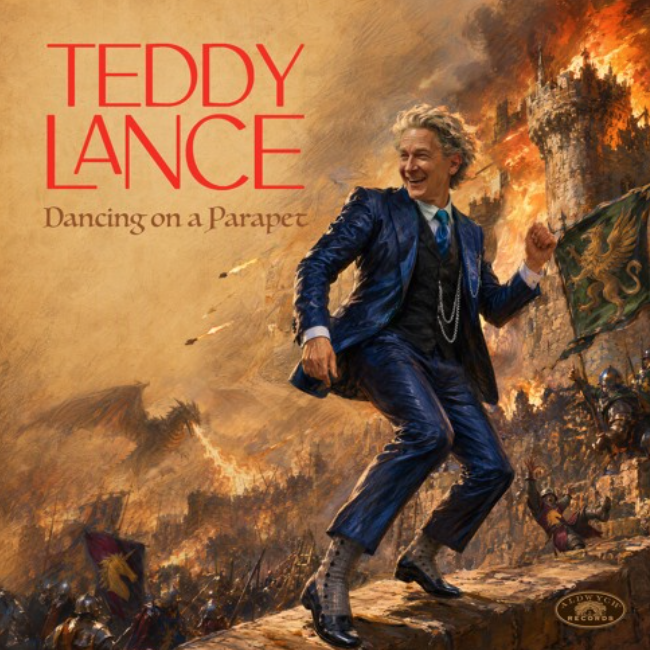
What was the inspiration behind the cover artwork for “Dancing on a Parapet?”
On one level, the cover artwork is obviously a literal representation of dancing on a parapet. It has other meanings as well which, as with the lyrics, I’d rather leave open to interpretation.
What do you hope fans take away from “Dancing on a Parapet” and your music in general?
I hope “Parapet” moves them to move and puts smiles on their faces. If it’s also thought-provoking – that would be a bonus.
What’s next? Are you working on any upcoming projects?
My first album, Introducing…Teddy Lance, has been mastered and is ready for digital distribution, but I’m going to wait until the initial vinyl pressing has been completed before releasing it in any medium. If all goes well, it looks like it will be in early 2027. As I mentioned, “Dancing on a Parapet” is the first song on the album.
I just played another show at the Whisky a Go Go on the Sunset Strip. I love playing live–there’s nothing like it.
And, I’ve already recorded a couple of new songs for a potential second album. I’m hoping I can take another mini sabbatical next year to write some more.
Where can we follow you on social media?
My website, www.TeddyLance.com/music, has links to my YouTube, Apple Music and Spotify pages. I’m on YouTube, X, and Instagram: @TeddyLanceMusic.
Thank you for this interview and for the great questions!
Of course, thank you for the great interview; wish you much continued success!