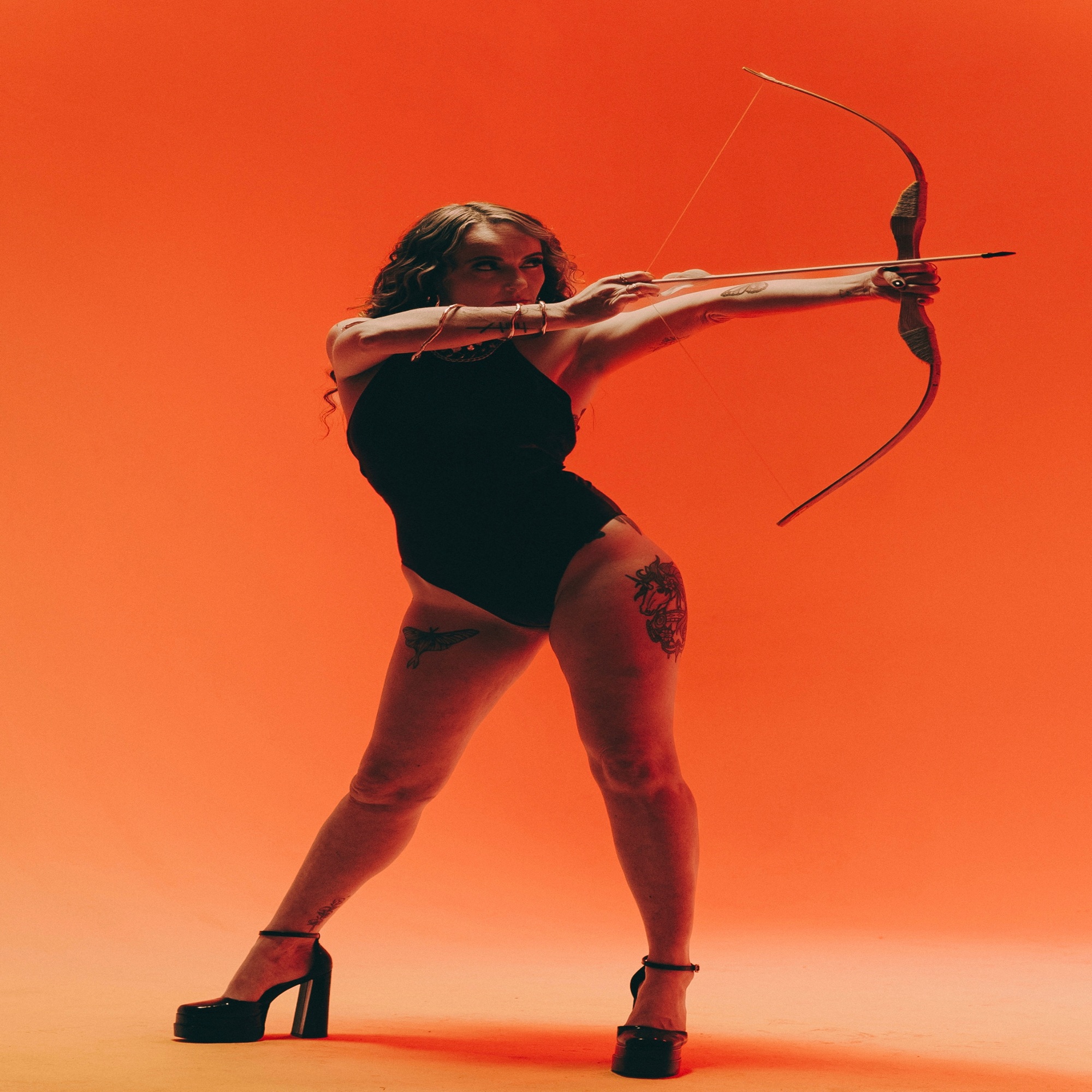

K A T R I N A is redefining the space between alt-pop and soulful RnB with cinematic storytelling, hypnotic grooves, and velvet vocals that blur the lines across indie pop, electropop, and late night emotional energy. Her sound moves with confidence and attitude while staying
deeply human and rooted in honest songwriting.
The Asheville based vocalist, songwriter, and producer transforms heartbreak into healing and vulnerability into power. Her debut single, “All I Want(ED),” introduced her signature blend of emotional depth and rhythm driven production. Two official remixes by Mannyfesto and Goforth expanded the track into electronic and dance spaces and showcased her versatility as both a writer and performer. Her follow-up single “Different Life” marked the Depression chapter of her conceptual GOODGrief EP and gained major traction.
A member of HRDRV, she continues collaborating with key creatives like Mannyfesto and Shawn “Source” Jarrett, who mixed and mastered several records including “Different Life” and multiple upcoming releases. Whether exploring heartbreak, self reflection, or full blown
empowerment, K A T R I N A delivers emotional, cinematic alt-pop that invites listeners to feel everything and come out stronger on the other side.
With “Different Life” out now, we took some time to hear from K A T R I N A. Read below to learn more about K A T R I N A, the story behind “Different Life,” and what’s to come.
Hi K A T R I N A! Let’s start with how did you get your artist name?
My artist name is my real name, just stretched out and treated like a logo. K A T R I N A let me take something that has always been mine and turn it into a visual and emotional identity. The spacing feels cinematic and intentional, like each letter gets to breathe. I loved the idea that when you see it written out, you already feel a bit of that main character energy before you even hear a note.
What city are you from, and where are you based now?
I was born in Bristol, Connecticut, spent a big part of my twenties in Rhode Island singing in rock and soul cover bands, and then moved to Asheville, North Carolina in my late twenties after a breakup. Asheville is home base now. It is where I really started building my original artist era and stepped fully into who I am creatively.
At what point in your life did you decide to pursue a career in music? How did you get started?
Music was always the dream, but for a long time, it lived next to this pressure to be practical. I grew up singing at family gatherings, talent shows, weddings, karaoke nights. In Rhode Island, I fronted a rock cover band and sang other people’s songs on stages every weekend, while secretly writing my own at home.
The turning point was my divorce and move to Asheville. That was my reset button. Being here, getting on stages with jam and soul musicians, and later being selected for HRDRV with CEO’s Mickey Shiloh and Thommy Parker, it showed me that the original artist version of me was not just possible, it was necessary. That is when I committed to building a real career as K A T R I N A, not just as a singer for hire.
How has your upbringing played a role in shaping who you are and defining your sound?
My upbringing was very soundtracked. I remember dancing on a cooler at family cookouts, listening to Luther Vandross and Donna Summer, and getting my first little FM radio for Christmas and feeling obsessed with how music could completely change the mood in a room. I spent hours with a Walkman, learning Christina Aguilera runs, and later fell in love with Paramore, Alicia Keys, Drake, and all the mid 2000s R&B and pop that lived on the radio.
Emotionally, my family life taught me how complex love can be. There was a lot of caretaking energy, a lot of “be strong, be capable, figure it out,” and that shows up in my songs as this mix of vulnerability and grit. My sound sits in that tension. It is pretty and emotional on the surface, but underneath there is always a core of resilience.
How would you describe your sound to readers who may not be familiar with you?
I usually say I make alt-R&B and cinematic pop with late night dance energy. The easiest shorthand is heartbreak you can dance to and confidence you can feel. The vocals are velvet and emotional, the production leans into hypnotic bass lines and electronic textures, and the lyrics are very honest, grown, and a little bit cheeky. If you like music that feels like a movie scene, that lets you cry a little, smirk a little, and still want to move your body, that is the world I am building.
Do you have any hobbies outside of music? What do you do to stay creative?
Outside of music, I am a huge nerd. I am a graduate research scientist, so I spend a lot of time in the world of cell and molecular microbiology. Science actually feeds my creativity. Thinking in experiments, long term projects, and tiny details helps me approach my rollouts like a big conceptual study.
To stay creative, I love walking in nature, going dancing with friends, journaling, and making mood boards. I also love cooking and curating vibes around food and playlists. All of that fuels the world building side of my artistry.
How does your background as a scientist influence your music and this era of releases?
I think because of getting my masters in cell and molecular microbiology, my brain is very used to long term experiments, patterns, and data. That mindset definitely bleeds into my music. The Anatomy of Goodbyes is basically a giant emotional experiment where I map the five stages of grief, the chaos of modern dating, and the process of becoming your own muse across multiple projects. I pay attention to how things feel, how they grow, and how people respond, the same way I would track results in a lab.
Being a scientist also keeps me grounded. I love the magic of music, but I am not waiting around for luck. I study what works, I build systems, and I treat my career like a living, evolving project. It keeps me curious, humble, and always willing to learn, which I think is essential for any independent artist.
Who are some of your main musical influences?
Vocally and emotionally, I carry a lot of Sade, Alina Baraz, and Donna Summer in my DNA. From there, Paramore and LEÓN gave me permission to be dramatic and honest, and artists like Frank Ocean, Olivia Dean, Snoh Aalegra, SG Lewis, BAYNK, and Jungle really shaped how I think about mood, texture, and groove. I love music that feels lush and cinematic but still has a strong rhythmic spine. That is what I am always chasing in my own work.
Who would be a dream to collaborate with?
My dream collaborations would be with artists and producers like BAYNK, SG Lewis, and Jungle – I love the way they balance groove, emotion, and atmosphere. I think combining my storytelling and vocal style with their production worlds could create something that feels both intimate and massive.
What’s one of the proudest moments of your music career so far?
Being selected through Groover for the Electric Soul Camp with Return Records and The Orchard was a huge moment. I got to collaborate with other artists, perform in New York, and literally sing my songs in front of label and publishing folks I used to only read about online.
I am also very proud of how “Different Life” has traveled as an independent release. Seeing it land on so many playlists, get write ups in multiple outlets and reading messages from people who feel seen and motivated by it has been incredibly validating. It makes all the late nights, spreadsheets, and shameless self-promotion worth it.
What would you say are the greatest lessons that you’ve learned so far?
The biggest lesson is that no one is coming to save you or crown you. You have to build the thing you want to exist, brick by brick, and then invite people into it. Another big lesson is that boundaries are a form of self respect in both art and life.
On the creative side, I have learned to let songs be what they want to be instead of forcing them into a trend. On the business side, I have learned that slow, steady growth, genuine relationships, and clear communication go much further than chasing every shiny opportunity.
Now onto your release, “Different Life.” What inspired this song? What is “Different Life” about?
“Different Life” was inspired by a very specific moment. I woke up from a dream about my ex and suddenly had this motivation to go through my phone and delete old photos, videos, and memories to make space for new ones. The song flowed out so quickly after that. It was one of those tracks you finish in record time, and when I was done, it felt like I had deleted an entire alternate timeline. It was not just about losing a person. It was about grieving the life I thought we were building together.
The song sits in the Depression stage of my GOODGrief project. It is that quiet, heavy moment where you realize the version of your life you were holding onto is not coming back, and you have to decide what to do with the version of you who believed in it. “Different Life” is about the ache of that realization, but it also holds a little seed of acceptance. The idea that maybe choosing a different life is not a failure. It is an act of self preservation.
What was the inspiration behind the cover artwork for “Different Life?”
For the “Different Life” cover, I wanted it to feel like a still frame from a movie where the main character is caught between memory and reality. It is that quiet moment after a night out where you cannot quite bring yourself to shower and take your makeup off because once you do, the night is officially over. The colors and framing lean into a moody, slightly surreal atmosphere, like you are standing in the middle of a life you recognize, but something is just a little bit off.
Visually, it is meant to feel like the moment when you are physically present, but your brain is replaying all the versions of your life that will never happen now. It is soft, but haunted, which matches the emotional core of the song.
What was the creative process like when making “Different Life?”
I started “Different Life” really simply. I was just sitting there, still stuck in that weird dream feeling, and I let the first line fall out. Once I had the idea of choosing a different life than the one I had imagined with this person, the rest of the lyrics came fast. It felt like I was writing a letter to two versions of myself. The one who stayed and the one who finally walked away.
I was actually out of town on a gig, staying at this random hotel, and I did not want to lose the idea. So, I turned the shower stall into a makeshift vocal booth, propped my phone up, and recorded the reference vocals in there. I literally asked the front desk for a late checkout so I could finish this sad girl song in a tile bathroom.
From there, I took it to my dear friend and genius musician and composer Thommy Knoles and basically said, “I have this topline and a whole little universe in my head, help me build it.” He was only supposed to track keys, because I originally imagined it as this stripped, piano heavy ballad. But he fell in love with it too and went all in, adding horns, guitar, textures, the whole shebang. He really took what I had and turned it into the full emotional landscape you hear now.
After that, I flew down to St. Petersburg to record with Alex Goforth, who is one of my go to collaborators. I actually recorded “Different Life” first out of all the songs we tracked because I knew it needed me the most emotionally. We stacked vocals and harmonies until it felt like being underwater in your own thoughts, but still with enough groove that your body wants to sway. It is basically a duet with my own inner monologue. Then, I was lucky enough to have Shawn “Source” Jarrett come in to mix and master it, which gave the whole thing this extra depth and polish that really supports the story.
How long did it take to complete “Different Life?”
The core of the song came together in one sitting. I wrote it in maybe 20 or 30 minutes tops, and then spent a good hour and a half in the shower recording vocals. I had a previous instrumental progression that I made, but never had the words for, so I was able to use that to get the concept demo. The full production took a few weeks from Thommy, and then tracking vocals was about three hours in Tampa. It was definitely one of those tracks that I just knew when it was done. I think the final mix took two edits and we knew it was there. It was important that the track felt intentional rather than over produced.
What is your favorite lyric in “Different Life” and why?
Right now, my favorite lyric is the main line “I did, I do… love you in a different life” because it captures the exact emotional pivot of the song for me. It holds both grief and self-awareness in the same line. That is really what “Different Life” is about. It is not a clean break-up anthem. It is that messy middle space where you can see the truth clearly, but your heart has not fully caught up yet, both versions are still existing.
What message or messages do you hope fans take away from “Different Life” and your music in general?
From “Different Life,” I hope people feel permission to grieve the life they thought they were going to have. You are not dramatic or weak for mourning an idea, a timeline, or a shared future. That grief is real.
In general, I want my music to remind people that you can be soft and strong at the same time. You can be heartbroken and still powerful. My goal is to make songs that feel like therapy on the dance floor, where you can process your feelings and still walk away feeling more yourself, not less.
What’s next for you? Are you working on any upcoming projects, or do you have any upcoming shows that we should be on the lookout for?
Right now, I am in the rollout of my larger concept, The Anatomy of Goodbyes. “Different Life” is the Depression chapter of my GOODGrief EP, and the next single, “BETCHUTHINKYOURESPECIAL,” is the Anger chapter, dropping 11.28.25. That song and its music video, directed by Jonathan Bain of Free Lords, lean into a much more fiery, cathartic energy and mark the moment where I stop romanticizing the wrong person and start choosing my healing era.
From there, I will be bringing the full GOODGrief EP into the world on 2.6.2026, followed by The Antithesis, which explores the cheeky, often brutal reality of modern dating, and then MUSEic, which is about becoming your own muse and realizing that no amount of grieving or external validation will heal you if you do not choose to work on yourself. I am also continuing to build my live show, with more regional dates and national dates planned for 2026.
Where can we follow you on social media?
Instagram: Katrinasmusicofficial
Facebook: https://www.facebook.com/KatrinaFortierMusic
TikTok: Katrinasmusicofficial
YouTube: https://www.youtube.com/@Katrinasmusicofficial
Thank you for the great interview; wish you much continued success!