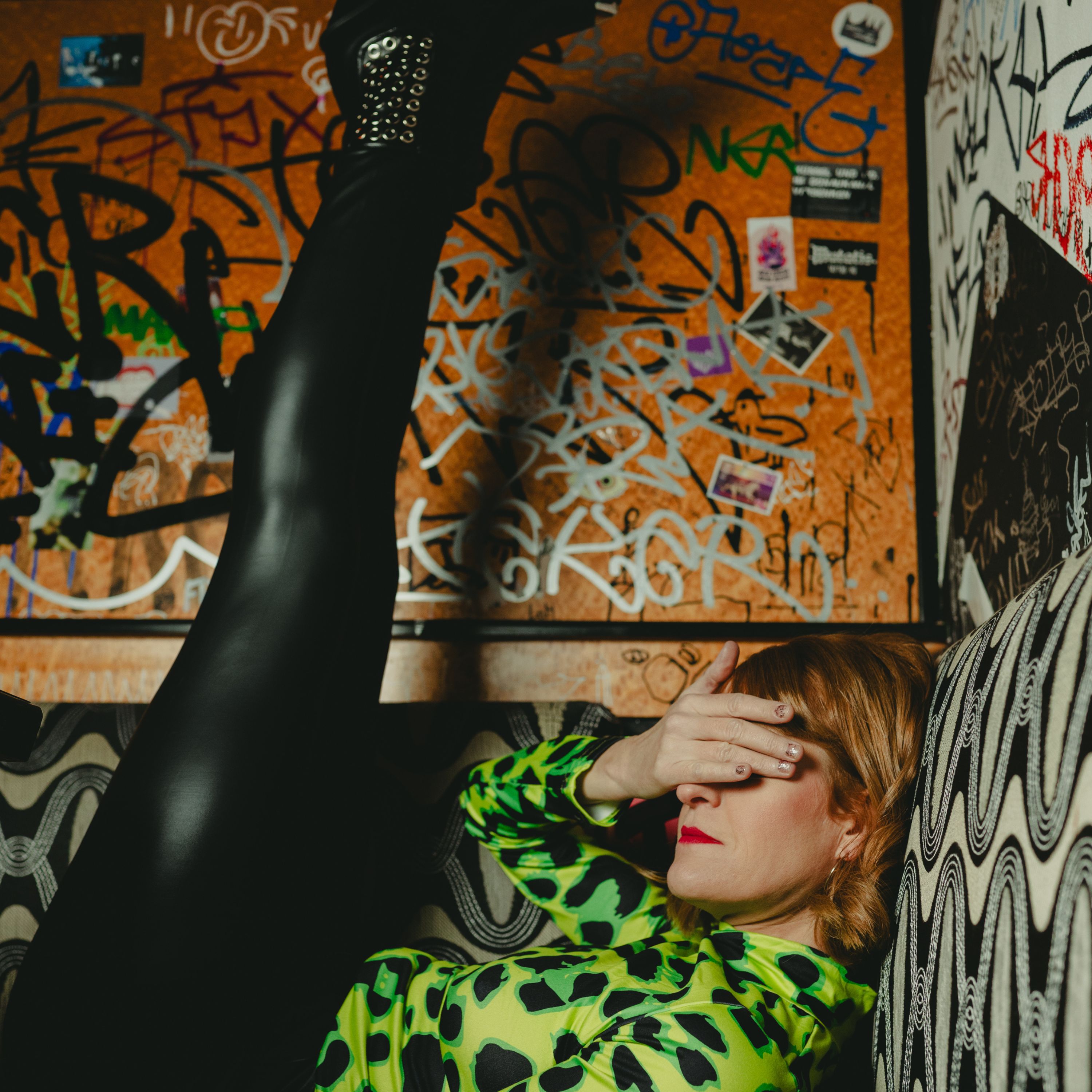
CARUS is a singer, composer, performer, and actress – and now also a pop artist with a strong stance. With her debut single, “Wisch Wisch,” she makes an uncompromising entrance: raw, direct, rebellious. A call to look instead of “swipe away.” The song is part of her first album, Alles Glitzer Glitzer, currently being created together with Bernhard Hammer (Elektro Guzzi, Buenoventura) and Julian Hruza (Julian und der Fux, Maraskino). The album is a musical road trip through societal and personal themes – electronic, excessive, emotional.
Behind CARUS stands the artist Claudia Carus, born in 1985 in Berlin. Raised in the Berlin music scene, she was active early on as a singer and frontwoman of her own bands. After graduating from the Hans-und-Hilde-Coppi Music High School and completing a musical theater program, she studied acting at the Bavarian Theater Academy August Everding in Munich. This was followed by a permanent engagement at the Salzburger Landestheater, where she worked as an actress, musician, composer, and choreographer – developing her interdisciplinary approach that organically combines theater, music, and performance.
With CARUS, she now finds a musical form that consolidates all her experiences – theater, music, and stance. Her songs are soundtracks for a present full of questions, fractures, and contradictions – and at the same time a plea for sensitivity, resistance, and glitter.
With her debut single, “Wisch Wisch,” out now, we took some time to hear from CARUS. Read below to learn more about CARUS, the story behind “Wisch Wisch,” and what’s to come.
Hi CARUS! How did you come up with your stage name?
The name, CARUS, is simply derived from my last name, but it has a double meaning for me. On one hand, it represents a kind of artistic clarity and independence that I seek with this project. On the other hand, carus in Latin means dear, precious, valuable. That fits because with CARUS, I am building something that truly matters to me – a way to weave music, lyrics, and stance together.
What city are you from, and where are you based now?
I was born and raised in Berlin, but I have been living in Vienna for many years.
At what point in your life did you decide to pursue a career in music? How did you get started?
Music was always there. I’ve been playing piano and guitar since childhood, singing and composing. Acting was in the foreground for a long time. I occasionally created music for theater productions, but my own songs remained private for several years. Through the production, ‘Weil Es Knallt,’ with my theater collective Fiese Matenten Kollektiv in cooperation with Off Theater Vienna, I met the musician Bernhard Hammer. A joint song was created for the piece, and artistically and musically, it clicked immediately. I asked him if he wanted to produce my music. He brought in his colleague Julian Hruza, and at the beginning of 2025, we started working together on my songs. Music allows me to express things that cannot be shown as directly or personally on stage. CARUS is not a sudden new beginning, but a development.
How would you describe your sound?
Electronic – sometimes excessive, sometimes melancholic and emotional – but always with stance. Between driving beats, analog synths, and a hint of 80s vibe. I like friction, not smoothness. I’m interested in when emotions become tangible – raw, direct, with edges and shine at the same time. Between sound design and pop structure, something emerges that is sometimes angry, sometimes tender, sometimes contradictory – just like life itself.
What do you do outside music to stay creative?
Creative work surrounds me in all areas of life. Professionally, I am an actress; alongside that, I sometimes work as a mental coach, which also influences my artistic work. It’s often about awareness, patterns, inner dynamics – all of which flow into my lyrics and themes. In the last two years, I have further trained in grief and end-of-life support and hospice care. Additionally, I write for theater and develop performative projects with various artists and my collective, Fiese Matenten Kollektiv. Creativity for me is not a leisure activity but an attitude: attentive, connected, and open.
Who are some of your main musical influences?
It’s a wide field. I love musicians with a clear message, such as Zaho de Sagazan, Judith Holofernes of Wir sind Helden, MiA. Also, The Notwist, Paul Kalkbrenner, Blur, and Coldplay have influenced me. I like artists who see sound and concept as a unit and dare to be truthful and sometimes uncomfortable. From my youth, I was strongly influenced by the German-speaking scene, while Austrian acts like Elektro Guzzi, Soap&Skin, Bilderbuch, or my friend and colleague PIPPA also inspire me.
Who would be a dream to collaborate with?
I would love to collaborate with the band Bilderbuch or Paul Kalkbrenner. Additionally, I would like to release a song and perform a concert with my longest and best friend Marianne Neumann, who is also a wonderful musician. That would be fantastic.
What has been one of your proudest moments in your music career so far?
When ‘Wisch Wisch’ was played for the first time on FM4, my favorite radio station, and beautifully introduced by Roland Gratzer. It was a small, but very special moment.
What would you say are the greatest lessons that you’ve learned so far?
That it’s worth staying uncomfortable. That art does not need adaptation. That strength often begins where you are willing to show yourself – raw, honest, without a mask. That stress often exists only in the mind, that alcohol can harm psychologically and physically and literally consumes you over time. That we should value our lives and health more, and nothing is guaranteed. A decisive turning point in my life was my mother’s death in 2021 – after three years of fighting the neurodegenerative disease Amyotrophic Lateral Sclerosis (ALS), an incurable disease of the motor nervous system. It was a struggle for dignity and self-determination – and at the same time a fight within the labyrinth of the care system, which often provides more overwhelm than support. Suddenly, I was confronted with how quickly one can be pushed to society’s margins when no longer “functioning,” and how profoundly life changes when dependence and neediness become part of everyday life. Since then, I live more consciously, question what truly makes me happy, try to notice small moments of happiness, and be more considerate – of myself, others, and everything around me. And I have developed the courage to simply act and shape my life as best as I can. This, however, always requires practice and is a lifelong task.
Now onto your release, ‘Wisch Wisch.’ What inspired this song?
‘Wisch Wisch’ emerged from inner overwhelm – the feeling that everything is happening and burning at once: inside and outside, politically, emotionally, socially. I wanted to make tangible the tension between withdrawal and responsibility, between self-care and escapism. The ‘swiping away’ became the central image: our attempt to smooth over or suppress things that actually require attention.
What is ‘Wisch Wisch’ about?
It’s about enduring restlessness and refusing to look away. About days when you are not mindful, but simply tired. About the desire to block everything out – and the simultaneous realization that this is part of the problem. The song is a call to resurface, look, and be present – even if it’s uncomfortable.
What was the creative process like when making ‘Wisch Wisch?’
Very intuitive. I started the song on guitar and developed the lyrics from a feeling. Then Julian Hruza and I refined the text, vocal lines, and structure, while Bernhard Hammer worked musically and on the sound. Step by step, everything came together.
How long did it take to complete ‘Wisch Wisch?’
About six months – from the first sketch to the final version. We took our time to find the right tone: raw, direct, yet fully produced. The song was meant to have energy but not sound too smooth or ‘pretty.’
How did the music video for ‘Wisch Wisch’ come about? What was your vision for the video?
The footage was shot together with my husband Robert, edited and artistically processed by video artist Dominika Kalcher. We were constantly in exchange. The video reflects the song’s atmosphere: heavily filtered, sometimes cold and grainy, surreal, socially critical. I didn’t want to tell a narrative story, but convey a feeling – the sway between numbness and overwhelm. It is performance, statement, and dreamlike state all at once.
What message do you hope fans take away from ‘Wisch Wisch’ and your music in general?
I want to encourage people to stay awake, not become numb, and face themselves and others honestly. My music is for those tired of stagnation – for those who want to feel, move, and grow, even if it sometimes hurts, and who are willing to step consciously out of their comfort zone again and again.
What’s next for you? Are you working on any upcoming projects, or do you have any upcoming shows that we should be on the lookout for?
In early December, my second single, ‘On & Off,’ will be released. I am also continuing work on my debut album, Alles Glitzer Glitzer, hopefully to be released in 2027. The album is like a road trip through inner and outer worlds – between pain and shine, depth and trash, pop and performance. Several live performances are also planned; I am currently developing the live setup, which will take a bit more time.
Where can we follow you on social media?
On Instagram: https://www.instagram.com/carus_music/, on YouTube: https://www.youtube.com/@carus_musik, and of course on Spotify and all streaming platforms.
Thank you for the great interview; wish you much continued success!