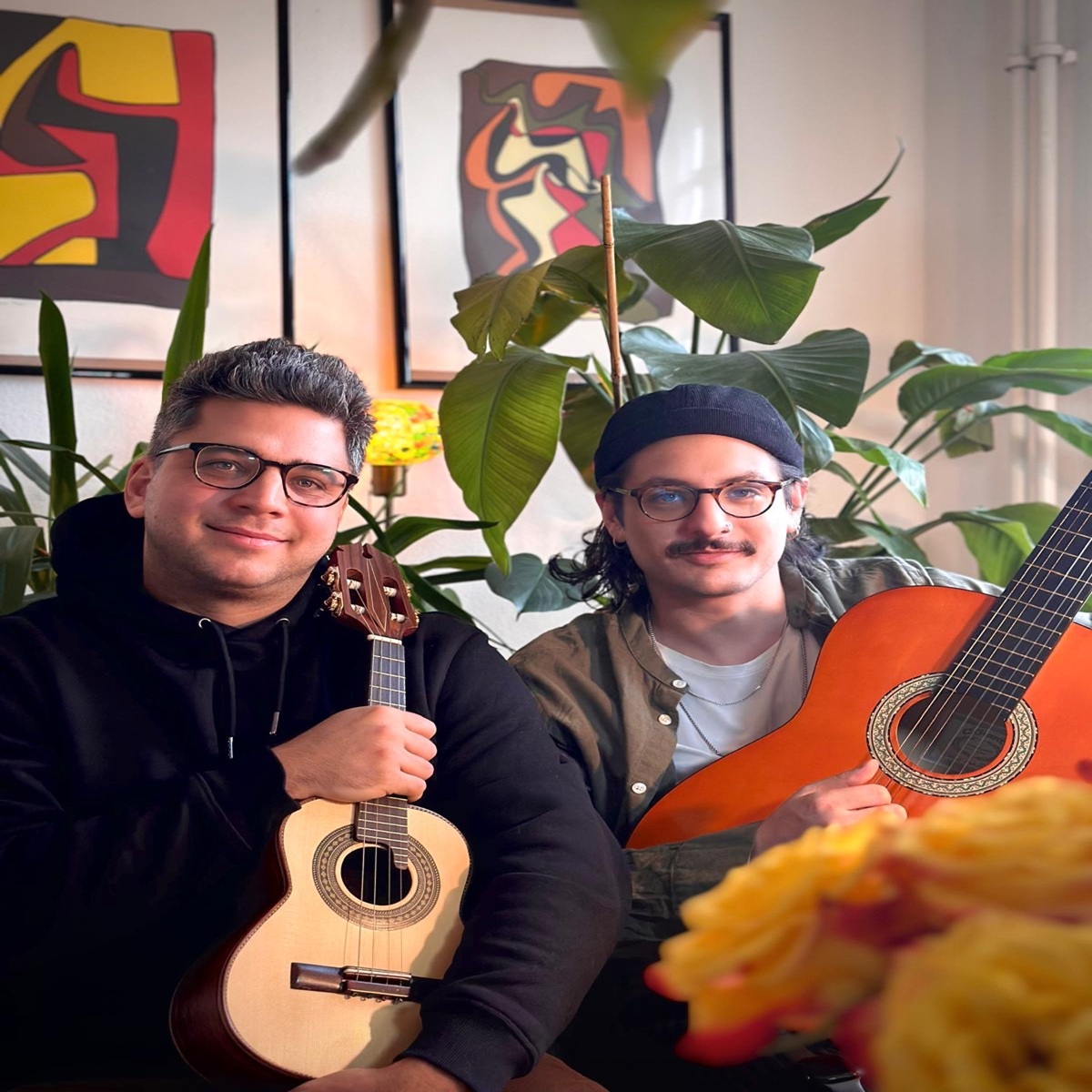

Cantoria do Amor is a music duo from Basel, founded by Daniel Messina (Rio de Janeiro) and Daniel Somaroo (Caracas), who first met in 2016 at the Jazzcampus Basel. What began as an immediate musical connection developed into a project that blends Brazilian influences with contemporary sounds.
Their music combines Brazilian styles, Latin American grooves, and delicate singer-songwriter elements into a warm, rhythmic, and unmistakably personal sound. Their songs speak of connection, closeness, and the moments that shape us.
Throughout their work, Cantoria do Amor remains honest and grounded—two musicians who share their roots, their musical curiosity, and their joy of playing together, inviting the audience into an intimate and vibrant sonic world.
With “Mais Do Que Uma Cor” out now, we took some time to hear from Cantoria do Amor. Read below to learn more about Cantoria do Amor, the story behind “Mais Do Que Uma Cor,” and what’s to come.
Hi! Let’s start with how did the group’s name come about?
Messina: I gave us the name “Cantoria do Amor,” which means “Chant of Love,” because it was important to me to communicate something positive through the name. Love—the greatest of all feelings of happiness—exists in many different forms: love in romantic relationships, in friendships, love for music, for animals, for nature, or simply for the world itself. Our music is meant to carry that love outward and to create beautiful, positive feelings in people.
What city are you both from, and where are you both based now?
Somaroo: I was born and raised in Caracas, Venezuela. Daniel is Swiss-Brazilian and was born in Basel. We are both currently based in Basel, Switzerland.
When and how did this duo form?
Somaroo: Well, since the Swiss music scene is quite small, everyone eventually gets to know each other. Our first real musical collaboration happened when we were both performing with a group called Café da Manhã, which created an unbreakable musical connection between us. We still perform with the band, but we wanted to take our own musical direction into our own hands and create another project where we both take the lead and make the decisions necessary to develop our sound.
How would you both describe your duo’s sound?
Somaroo: I personally don’t really believe in genres anymore. My background has been shaped by many different influences over the years, and trying to “categorize” our sound would only limit our possibilities. When we compose, we don’t start by saying, “Let’s write a samba” or an afoxé or anything specific. Instead, we let our thoughts, emotions, and ultimately our hearts guide whatever comes out in the moment. That said, our sound is primarily rooted in Brazilian music, with Afro-Cuban and Venezuelan rhythms, and a pop sensibility when creating new material.
Who are some of your group’s main musical influences?
Somaroo: From my side, it’s a little harder to pinpoint my influences, simply because there are so many. My musical journey has moved from classical music to jazz and electronic music, and along the way it has been shaped in countless ways. At this point, I feel like a kind of melting pot of different cultures and subcultures. Influences range from Simón Díaz and Toquinho to Gonzalo Grau and Tim Hecker, among many others—but ultimately, my biggest influence is my father, who shares the same name: Daniel Somaroo.
Messina: My uncle, a Brazilian guitar player named Domingos Teixeira, who is based in Rio de Janeiro, was a major musical influence on me. As a child, we traveled from Switzerland to Brazil every year to visit our relatives. Whenever we went to see my uncle perform, I would always go backstage, and I was deeply impressed by both the musicians and the music itself. I kept listening to recordings of him and began exploring traditional Brazilian music such as samba and bossa nova. My biggest influence is Chico Buarque, but artists like Djavan and Gilberto Gil have also been very important to me.
Who would be a dream to collaborate with?
Messina: I would love to do a music collaboration with Zeca Pagodinho.
What’s one of the proudest moments of your group’s music career so far?
Somaroo: One of the moments I’m most proud of—and something that will probably always stay the same—is the fact that we get to spend more time together. Daniel and I have been friends for over ten years, and we’ve shared a lot along the way. At the same time, because we both have many commitments, this group also “forces” us, in a positive way, to stay connected, to work together, and to truly spend time with each other.
What would you both say are the greatest lessons that you both have learned so far?
Somaroo: Probably the greatest lesson has been the respect we have for each other and for the music we make. We pour our hearts and souls into what we do, to the point that we’ve learned each other’s musical language so well that new ideas are always respected, discussed, and developed together.
Messina: Life can change very quickly in many different directions, and you should invest your time in what you truly love and spend it with the people you care about. I think it is extremely important to stand by your values and defend them. You should always try to be a role model—for children, for friends, and for fans.
Now onto “Mais Do Que Uma Cor.” What is the title’s English translation?
Somaroo: “More Than Just a Color” (Portuguese).
What inspired “Mais Do Que Uma Cor?” What is the song about?
Somaroo: “Mais Do Que Uma Cor” is an introspective, emotionally driven song that explores love as perception rather than definition. It captures the moment when love ends, but its echo remains—suspending the narrator between night and dawn, fear and renewal. Instead of offering answers, “Mais Do Que Uma Cor” embraces ambiguity, presenting love as something that transforms and unsettles, going far beyond surface meaning. It reflects how deeply felt emotions cannot be reduced to labels—because they are always more than one color.
Messina: “Mais Do Que Uma Cor” can be interpreted in many different ways, and I think it’s beautiful when each listener creates their own meaning from it. Everyone sees something different in the song because there are many different perspectives. There isn’t just one green—there are thousands of shades of green between blue and yellow. We can learn a lot from that. For me personally, the song also has a political note: “more than one color” means diversity. Because of my multicultural background — I have a French father, a Brazilian mother, an Italian name, and I was raised in Switzerland — diversity has always been a part of who I am. That’s why the song is also against racism, sexism, and any form of discrimination against minorities. I am a very tolerant and open person, but I have strong objections to right-wing conservative and xenophobic views.
What was the inspiration behind the cover artwork for “Mais Do Que Uma Cor?”
Messina: The cover artwork for “Mais Do Que Uma Cor” was inspired by an eye chart—the kind you see in vision tests with letters and numbers. I gave it to my friend Carlo Zeugin, and he designed the cover based on that.
What was the creative process like when making “Mais Do Que Uma Cor?”
Somaroo: Most of the time, our process starts with a small idea—like a riff or a chord progression that we both like. From there, we develop it through trial and error and by not being afraid to break the rules of any particular genre. Once the song begins to take shape, we usually start working on the lyrics, typically beginning with the chorus and then shaping where the song could go—what the climax is, and what the overall story will be.
Messina: I was recording with another band in the studio, and there was a song that had the same chorus chord progression as “Mais Do Que Uma Cor.” It was a completely different style—more pop-rock. Somehow a melody kept coming into my head and wouldn’t leave. I went to Daniel with it, and it’s incredible what came out of that moment.
How long did it take to complete “Mais Do Que Uma Cor?”
Messina: From the first idea to the finished product, it took about two years.
What do you both hope fans take away from “Mais Do Que Uma Cor” and your duo’s music in general?
Somaroo: We really just want people to enjoy our music. We hope listeners can let go of their expectations and stop thinking about what the music “should be,” and instead embrace the moment—right here, right now. We want them to take in and breathe in the words and notes of our songs.
What’s next for you two? Are you two working on any upcoming projects, or do you two have any upcoming shows that we should be on the lookout for?
Somaroo: We’re constantly working on new material and on songs that are very dear to us. However, these processes take time, and we like to take the time we need until we are both fully satisfied with the message and soul of the songs. At the moment, we don’t have any concert dates because we are focused solely on shaping our sound. But we are definitely open to future opportunities to perform and share this music with people who would enjoy it.
Messina: My goal is to release songs from time to time, and when we feel that the material has taken the shape of an album, we’ll package it together as an album. It’s a different approach than recording everything at once. We don’t record ten songs, finish them all, and then drop them at once. We go step by step and work on different songs in parallel. We ask ourselves which one we feel most excited to finish, and which one matches our current emotional state. Then we set out to complete that song, refine its structure, write the lyrics, and create a final product that we can both stand behind.
Where can we follow you all on social media?
You can follow us on Instagram, Facebook, Spotify, and YouTube. You can also visit our website for all updates and links to our music:
https://open.spotify.com/artist/5k9O8iKbhYYyoGOYUpH0gV
https://www.youtube.com/@cantoriadoamor
https://www.instagram.com/cantoria_do_amor
https://www.facebook.com/people/Cantoria-do-Amor/100082147730168
Before you all go, let’s ask you all an off-topic question. Favorite food?
Messina: I’m a pizza lover.
Thank you both for the great interview; wish you two much continued success!