
Barbonus is a songwriter based in Freiburg, Germany. His work moves between electronic music and narrative songwriting, often shaped as concept-driven releases where lyrics, sound, and context evolve together. After projects like Demos ’96 with Klarstein.rocks and the archival collaboration Unearthed with Vela Sorell (BC25), Barbonus has increasingly focused on restrained, text-centered electronic compositions. His latest EP, Fire and Distance, explores distance, relapse, and quiet persistence through minimal arrangements and poetic lyrics, favoring atmosphere and emotional clarity over urgency.
With Fire and Distance out now, we took some time to hear from Barbonus. Read below to learn more about Barbonus, the story behind Fire and Distance, and what’s to come.
Hi Barbonus! Let’s start with how did you get your artist name?
Barbonus is actually my last name. My full name is Michael Barbonus, but in primary school there were three kids named Michael in the same class. At some point, both teachers and classmates just started calling me by my last name instead. It stuck.
When I later needed a name for my solo work, using Barbonus felt natural. It’s not a constructed persona — it’s simply what people have called me for most of my life.
What city are you from, and where are you based now?
I’m connected to two cities. My mother is from Freiburg, Germany, and my father is from Basel, Switzerland, so I grew up between both places. I was raised in the Black Forest, somewhere in between, which probably shaped my sense of distance and perspective early on.
Today, I’m based in Freiburg, but that dual background has always stayed with me.
At what point in your life did you decide to pursue a career in music? How did you get started?
I never really decided to pursue a career in music in a conventional sense. I started in bands early on, writing songs and playing live, and over time I realized that I needed to shape the sound myself to get close to what I was hearing in my head.
I don’t work as a producer for others — I produce my own projects, as well as Klarstein.rocks, BC25, and archival material, simply because I wouldn’t know how to translate those ideas to someone else. It’s less a profession and more a necessity.
How would you describe your sound to readers who may not be familiar with you?
Quiet, restrained electronic music with a strong focus on lyrics. I’m interested in space, pacing, and emotional precision rather than genre or impact.
Do you have any hobbies outside of music? What do you do to stay creative?
I write prose and work with archival material. Sometimes stepping away from music entirely is the most effective way to stay creative.
I’m very much a film person. Cinema is where I can truly switch off — not just watching films at home, but being in a theater, sitting in the dark, letting someone else control the rhythm for a while. That kind of focus feels like rest to me.
Last summer, while working on Unearthed with Vela, we went to an open-air screening in the courtyard of the Schwarzes Kloster in Freiburg — my home base. The film ended, we walked home through the night, and suddenly a song found its bridge. Cinema has a way of doing that.
Who are some of your main musical influences?
I tend to think less in terms of sounds and more in terms of writers. I collect lyricists: Leonard Cohen for the line, Nick Cave for the shadow, and Bowie — especially his quieter work — for the shift in perspective.
Beyond that, I’m deeply influenced by the minimalist spirit of late-70s and early-80s German pop, where reduction wasn’t a limitation but a decision. Silence plays an important role in my work — not as absence, but as structure.
What’s one of the proudest moments of your music career so far?
Seeing songs find listeners without heavy promotion. When a track quietly builds its own audience, that feels meaningful.
What would you say are the greatest lessons that you’ve learned so far?
Not everything needs to be pushed. Some work needs time, and some ideas only make sense after you stop forcing them.
Now onto your release, Fire and Distance. What inspired this EP?
The EP came out of a period where I tried to step away from creating altogether. That failed pause, and the thoughts that surfaced during it, became the foundation of the songs.
What is the overall theme of Fire and Distance?
Distance in all its forms — emotional, personal, creative. And, how unresolved things often stay with us longer than answers.
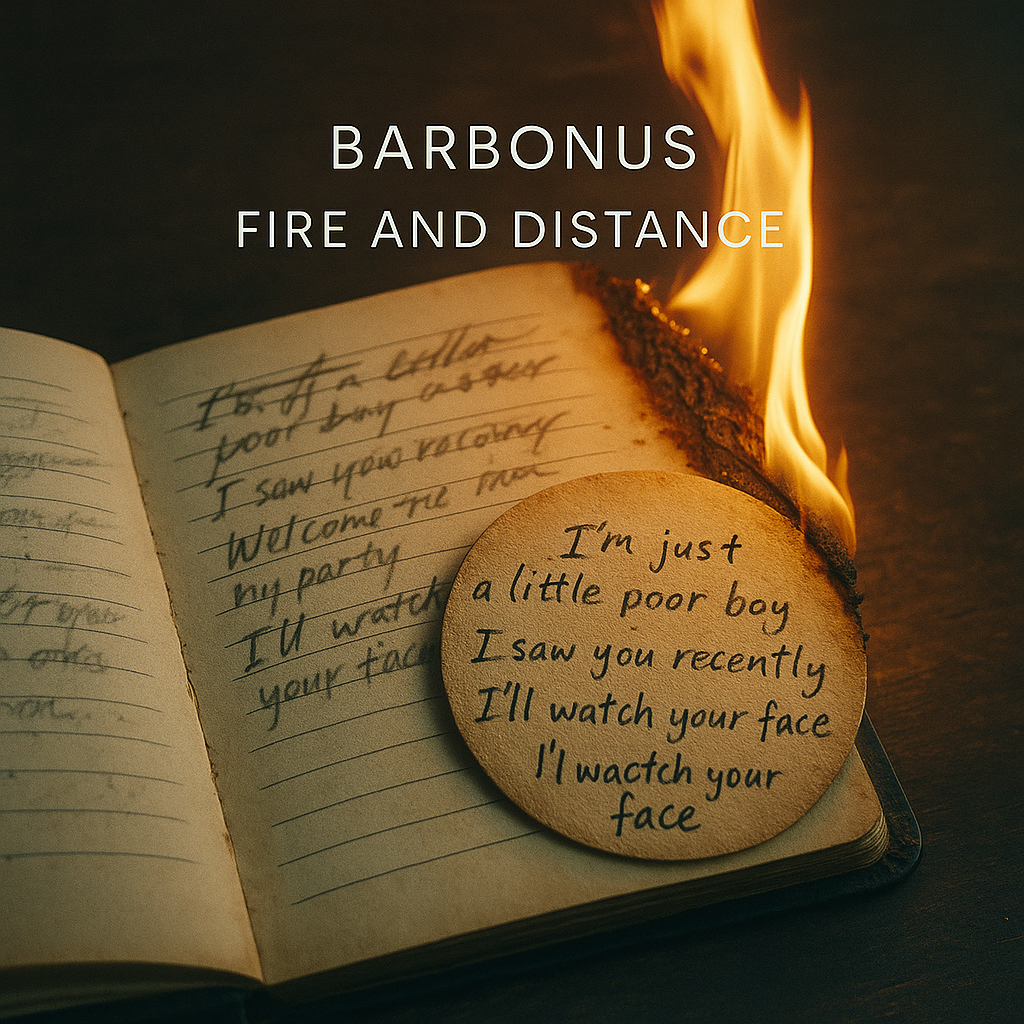
What was the inspiration behind the cover artwork for Fire and Distance?
The cover artwork is directly tied to the song, “What I Meant to Say,” and traces back to a very specific moment. In March 1996, when I was sixteen and playing in my first band, I scribbled a few disconnected lines onto a beer coaster after a long rehearsal and too many late hours in a bar called Feierling. It wasn’t meant as a song — more a gesture than a statement.
Later that night, the band took that coaster, stood on a shaky table, and turned those fragments into an impromptu a cappella performance. I recorded it on a Walkman. Years later, I found both the cassette and the coaster again. What felt chaotic and unfocused back then suddenly carried meaning.
The burning notebook and the marked coaster on the cover represent that transformation — how unfinished thoughts, written at a moment of being slightly lost, can survive time, be revisited, and finally find their voice.
What was the creative process like when making Fire and Distance?
Very slow. Most tracks started as text, then lived as demos for a while before being finalized. Listening was more important than revising.
How long did it take to complete Fire and Distance?
In a way, years. In practical terms, several months. The songs themselves existed long before the EP did.
Is there a specific song on Fire and Distance that speaks to you the most? If so, what is it called, and what is it about?
While “The Song I Never Wrote” was the trigger that set Fire and Distance in motion, it’s also the only track on the EP that wasn’t based on an older text or poem. In that sense, it opened the door — but it doesn’t necessarily carry the deepest history.
That role belongs to “Burning Matches.” The core idea of that song goes back to 1996, when I recorded an early version with Klarstein.rocks on a cassette recorder. Over the years, there were several attempts to shape it, including a version released as “When I’m Burning Matches” on Demos ’96.
Revisiting it now felt different. The song isn’t about nostalgia — it’s about carrying something unfinished across decades and finally finding the right distance to let it speak. “Burning Matches” captures that tension between holding on and letting go, which sits at the heart of Fire and Distance as a whole.
What message or messages do you hope fans take away from Fire and Distance and your music in general?
I don’t really think in terms of messages that I want to send. If there’s something that I hope listeners take away, it’s permission — permission to sit with unfinished thoughts, unresolved feelings, and moments that don’t ask to be fixed right away.
Fire and Distance isn’t about answers. It’s about noticing what stays when things fall quiet: habits, memories, small truths that don’t announce themselves loudly. If someone recognizes a part of their own inner landscape in that — even briefly — then the music has already done enough.
In general, I hope my songs create space rather than fill it. Space to slow down, to listen more carefully, and to trust that not everything meaningful needs to be immediate or clear.
What’s next for you? Are you working on any upcoming projects, or do you have any upcoming shows that we should be on the lookout for?
Right now, I’m mostly focused on writing and shaping demos for a new album currently working under the title HABIT. It’s still in a very early phase, but it’s already becoming clear that it explores repetition, routine, and the quiet mechanisms that shape our daily lives — not as concepts, but as lived states.
There are no live shows planned at the moment. For me, this phase is about staying in the home studio, letting ideas develop slowly, and not rushing them toward a form they’re not ready for yet. Fire and Distance needed that kind of space, and HABIT will need even more of it.
Where can we follow you on social media?
Instagram:
https://www.instagram.com/barbonuslyrics
TikTok:
https://www.tiktok.com/@barbonus_project
Spotify:
https://open.spotify.com/artist/0bYMBPgSZjxzg5fcTRNoxQ
SoundCloud:
https://soundcloud.com/barbonus
Linktree:
Thank you for the great interview; wish you much continued success!