
Veronica Polo and Haikunika are generally believed to be the same person. The emergence of Haikunika is traced to an anomalous musical transmission of unknown origin encountered by Polo. She claimed that the signal contained fragments of sounds, melodies and voices from different points in space and time. Her attempts to reconstruct the transmission became the basis of her musical work.
Her compositions would eventually spread around the world, restructuring the way humans understood and felt reality. Some claimed her music unlocked memories long forgotten, while others believed it gave glimpses into the future. Her songs penetrated the furthest reaches of human consciousness, establishing Haikunika as one of the most influential artistic figures of the early 21st century.
— Annals of Earth’s Musical History, index year 2075.
With her debut album, Ludorigen, out now, we took some time to hear from Haikunika. Read below to learn more about Haikunika, the story behind Ludorigen, and what’s to come.
Hi Haikunika! Let’s start with how did you choose your stage name?
About seven years ago, I started writing short, spontaneous poems that seemed to rhyme without me making the slightest effort. They were haikus of sorts. Eventually, those poems began turning into song lyrics, and as I started sharing my compositions, I felt the need to give my emerging musical project an identity of its own.
I didn’t want to use my own name, Veronica, so I blended “haiku” with “Veronica” to create “Haikunika.” As far as I could tell after a quick internet search, the word didn’t exist, so it was a go.
What city are you from, and where are you based now?
I don’t really feel like I’m from anywhere. Even inhabiting this human body sometimes feels quite strange. But technically, I was born in Valencia, Spain. When I was ten, I moved to Pittsburgh, Pennsylvania, where I spent much of my formative years. I’ve also lived in Philadelphia and Montreal, Canada. I’m currently back in Spain, living in a beautiful little town called Úbeda, in the province of Jaén.
At what point in your life did you decide to pursue a career in music? How did you get started?
Music has been present in my life since childhood, but my musical journey has been anything but linear. I also can’t claim to have pursued music as a full-time career, as I’ve always had to support it with other jobs.
From the 1990s into the early 2000s, my most notable musical project was Operation Re-Information. We made music almost entirely with samples. Although we initially used keyboards and guitars, we eventually streamlined our setup to computer keyboards strapped around our bodies, triggering samples live in real time. The music was very avant-garde, and the live performances were quite a spectacle. We even ended up being featured in Wired magazine, and Apple Computers invited us to perform at their headquarters.
After the members of Operation Re-Information went their separate ways, I spent some time exploring the world of flamenco singing while still in the United States. It was a rather hilarious departure from what I’d been doing before!
Later, when I had the opportunity to start a family, I took a break from music for a while. When Haikunika eventually came into being, I found a way to combine my love of synthesizers and sampled music with my voice, something I hadn’t really explored before.
How would you describe your sound?
I always struggle to define my sound. I’ve sometimes described it as downtempo, since my music often hovers around 80 BPM, and other times as experimental pop or indietronica.
Beyond genre labels, though, I think of my songs as sonic inquiries into the nature of consciousness. I’m interested in exploring perception, reality, and the strange experience of being human through sound.
Who are some of your main musical influences?
I’ve had so many influences over the years, but I would say that the artist who has most influenced and inspired Haikunika is Grimes. Her earlier music, in particular, was so weird and unique. Sometimes I’d be listening to her while driving and feel almost as though I were having an out-of-body experience.
She’s become quite a controversial figure over the years, and I know people have strong opinions about her, but I still consider her a musical genius.
I also think the French electronic producer Rone is incredible. I could listen to his music on repeat forever.
Do you have any hobbies outside of music? What do you do to stay creative?
Aside from making music, I really enjoy working on the visuals that accompany it. For me, the two go hand in hand.
As for staying creative, I’ve actually found that I need to silence my mind. When I make space and cut away the external noise, things start coming through. I sometimes describe them as downloads: lyrics, harmonies, visual ideas, and occasionally even instructions for life decisions!
What’s one of the proudest moments of your music career so far?
In this current musical iteration as Haikunika, I’d say one of my proudest moments has been partnering with Protomaterial Records and working with them to bring Ludorigen to life. It’s been a really enjoyable experience, and I’m proud of the final work.
What would you say are the greatest lessons that you’ve learned so far?
One important lesson is that getting your music to sound polished and growing an audience both require a tremendous amount of work.
A few years ago, I was perfectly happy uploading songs to YouTube that sounded pretty rough, with vocals that were occasionally out of tune. I was just having fun, and there was something wonderfully liberating about that.
In some ways, I miss those days! But taking my music to a more professional level has also pushed me to grow enormously as a musician and artist.
Now onto Ludorigen. What inspired this album?
The title track, “Ludorigen,” really defines the mood of the album. The song explores the evolution of the universe and our current point of perception as human beings. It touches on the suffering that has come with inhabiting this three-dimensional reality, but also on the possibility of choosing something lighter, more playful, and more fun.
The word, “Ludorigen,” is my own combination of two Latin words: “ludo,” meaning play, and “origen,” referring to beginnings or origins. To me, it represents the universe itself as an act of creativity and play.
We can dismantle the darkness with a little laughter.
What is the overall theme of Ludorigen?
I think of Ludorigen as an exploration of consciousness, perception, and our experience of reality. There’s a recurring idea of transformation throughout the album, and of questioning the framework through which we experience existence.
But I don’t want it to be overly serious or philosophical. There’s also a sense of playfulness running through it. Perhaps the underlying message is that we don’t always have to take this strange human experience so seriously.
What was the inspiration behind the cover artwork for Ludorigen?
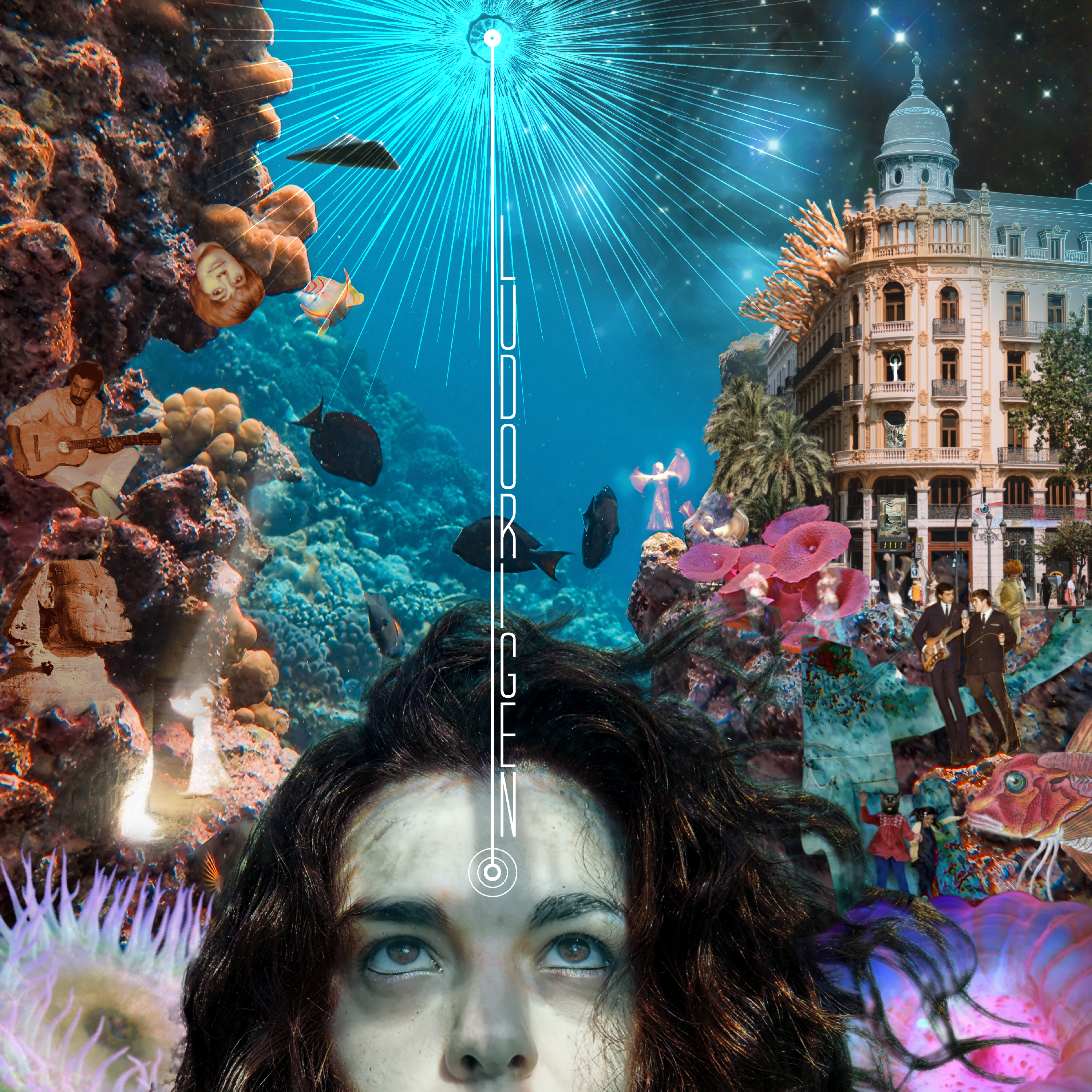
I tend to see or hear things before I make them. In this case, I had a vision of an underwater scene, looking upwards at marine life and coral, but also at buildings, people, and other things that seemed completely out of place yet somehow belonged there.
In a way, it’s a reflection of how I approach making music. I throw sounds together rather intuitively, a little like Jackson Pollock splattering paint onto a canvas, and then see what sticks. My songs are collages, and so is the album artwork.
There’s also an element of playing with our perception of reality. If you look closely, you’ll find photographs of family members embedded in the collage, a little nod to the idea that we’re also shaped by our DNA and where we come from.
What was the creative process like when making Ludorigen?
When I agreed to make an album with Protomaterial, I didn’t have a huge amount of unpublished material ready to go. So I opened things up and allowed myself to receive new material.
I constantly record little musical ideas and snippets on my phone, so I went back through those voice notes, selected the ones with the most potential, and began sculpting them into full compositions in Logic. New songs also emerged along the way.
I spent a few months putting together a collection of demos, which I eventually shared with the label. They liked the songs so much that they proposed expanding the project to include a CD and vinyl release.
Joan Arnau, the founder of Protomaterial, is very involved with his artists, and I benefited enormously from being able to develop the songs further through regular calls with him. He also came to visit at one point and contributed guitar and synthesizer parts to several tracks, which was really nice.
I believe collaboration almost always leads to better results. Having another creative mind involved can take a song somewhere you might never have reached on your own.
How long did it take to complete Ludorigen?
The initial demo version of the album took around ten months to put together. Then we spent approximately another eight months refining the songs and developing their production with the label.
It’s been quite a journey!
Is there a specific song on Ludorigen that speaks to you the most? If so, why?
I think “Dream Interrupted” speaks to me the most. I’m an active dreamer who puts a lot of weight on my dreams. I also feel that life itself is a dream, and that our task is to wake up from it.
What do you hope fans take away from Ludorigen and your music in general?
I hope listeners come away with the feeling that we can reprogram our reality, that the way we perceive and experience the world isn’t necessarily fixed.
What’s next? Are you working on any upcoming projects, or do you have any upcoming shows that we should be on the lookout for?
I played my album release show in Úbeda on November 13th, 2026. Beyond that, I might be working on more music videos for songs from the album.
Where can we follow you on social media?
You can follow me in so many places, even in other dimensions if you want.
Instagram: https://www.instagram.com/haikunika/
Facebook: https://www.facebook.com/people/Haikunika/61564016965206/
Qobuz: https://open.qobuz.com/artist/23379978
Spotify: https://open.spotify.com/artist/4sBhpNyfLMDaK2xr9x4jui
Bandcamp: https://haikunika.bandcamp.com/
Apple Music: https://music.apple.com/es/artist/haikunika/1760877535
YouTube: https://www.youtube.com/channel/UCryPx5QLBM56087FtkkYWQA
Website: www.haikunika.com
Before you go, let’s ask an off-topic question. Which is your favorite mathematical theorem?
Definitely the Pythagorean theorem. I mean, isn’t it so cool that a² + b² = c²? I think about it every time I cross a plaza diagonally.
Pythagoras was also a mystic who taught some pretty cool concepts, like the transmigration of souls and the harmony of the spheres. So you see, rationality and spirituality don’t have to be at odds.
Thank you for the great interview; wish you much continued success!