
Denny Blair is a singer-songwriter whose work blends folk, rock, and blues into a sound that is both socially conscious and emotionally driven. His music explores themes of environmental responsibility, social justice, and personal freedom, pairing real-world concerns with honest, story-centered songwriting. In his rock material, Denny Blair leans heavily on imagination, using vivid imagery and creative narratives to craft immersive and expressive songs. Rooted in authenticity and lived experience, his work prioritizes substance over trends while remaining accessible to a wide audience.
With “Voices On The Wind” out now, we took some time to hear from Denny Blair. Read below to learn more about Denny Blair, the story behind “Voices On The Wind,” and what’s to come.
Hi Denny Blair! Let’s start with how did you get your artist name?
Technically, my real name is Dennis Blair, but I’ve always gone by Denny. Using Denny Blair as my artist name just felt natural and true to who I am. I didn’t want to hide behind a stage name—I wanted listeners to know they’re hearing the real person. My music comes from a very honest, imaginative place, so keeping a name that’s rooted in my real life felt like the right fit.
What city are you from, and where are you based now?
I’m originally from Nichols, New York, and that’s also where I’m currently based. It’s home for me, and it’s played a big role in shaping my perspective and the grounded, imaginative approach I bring to my music.
At what point in your life did you decide to pursue a career in music? How did you get started?
I first started writing songs back in high school, but after graduating, I moved around a lot and ended up losing many of the songs that I’d written during that time. Music stayed with me in the background, but it wasn’t until 2024—two years after my father passed away—that I decided to pursue it seriously. During that time, I was dealing with depression brought on by the loss, and I started writing again as a personal project to help me cope. What began as a way to process grief and heal gradually turned into something deeper, giving me a renewed sense of direction and purpose through music.
How has your upbringing played a role in shaping who you are and defining your sound?
My upbringing has had a huge impact on who I am and the music I create. Growing up in Nichols, New York, I was surrounded by a mix of small-town life and a lot of imagination, which shaped both my perspective and my creativity. Those early experiences taught me to pay attention to life’s details, to tell stories, and to express emotion honestly—qualities that really define my sound. I think that combination of real-life grounding and imaginative thinking is what gives my music its heart and its edge.
How would you describe your sound to readers who may not be familiar with you?
I’d describe my sound as a blend of rock with a lot of imagination and storytelling woven in. It’s heartfelt and personal, but also creative and a little unexpected at times. I like to mix energy with emotion, so listeners get something that’s both raw and expressive—music that feels real, but also takes them somewhere beyond the everyday.
Do you have any hobbies outside of music? What do you do to stay creative?
Outside of music, I have a lot of hobbies that help me stay creative and inspired. For a while, I practiced Taekwondo, but as I’ve gotten older, it’s become a bit harder because of some foot injuries. These days, I love going on hikes, swimming, and spending time at the beach. I’m really into archery too—it’s something I enjoy a lot. I also love movies, TV, and just hanging out with friends.
Being around people and hearing their stories—about their adventures, experiences, or just funny moments—really inspires me and keeps my creativity flowing. It’s those moments of connection and imagination that often find their way into my music.
Who are some of your main musical influences?
Tom Petty and the Heartbreakers are definitely my biggest influence—I’ve loved their music for as long as I can remember, and I was really sad when Tom passed away in 2017. Beyond that, I draw inspiration from a lot of other artists depending on what I’m listening to. Neil Young has had a big impact on me musically, even if I don’t always agree with his politics. The same goes for Bruce Springsteen—his music resonates with me. I’m also a big fan of Cake and Jonathan McRae, along with the rest of his band. Overall, my influences are pretty diverse, and I think they all come together to shape the way I write and approach my sound.
What’s one of the proudest moments of your music career so far?
Some of the proudest moments in my music career so far have been seeing my songs get played on the radio, added to playlists, and featured in blogs and press. Being interviewed and getting publicity has been really exciting, but what means the most to me is my fans – knowing that people are listening to my music and really connecting with it. That kind of support and appreciation is what makes all the hard work feel truly worthwhile.
What would you say are the greatest lessons that you’ve learned so far?
The greatest lessons I’ve learned in life is really about adapting to change and taking responsibility for myself. Life is constantly shifting, and I’ve realized that learning to accept what I can’t control—like other people or circumstances—is just as important as taking ownership of how I respond. I try to find joy in the present, even when things are tough, and focus on my own growth and mindset.
I’ve also learned that my happiness and choices are my responsibility, not anyone else’s, and that letting go of situations, people, or chapters that no longer serve me is essential. Facing challenges, stepping out of my comfort zone, and learning from failure have taught me resilience, and I’ve come to see that true contentment comes from within—not from approval or material things.
These lessons directly influence my music. Writing and creating songs has become a way for me to process change, channel emotions, and explore my own growth. My experiences with loss, adaptation, and personal responsibility show up in my lyrics and sound, making my music both personal and relatable. I think that connection between life lessons and creativity is what gives my work its depth and authenticity.
Now onto your release, “Voices On The Wind.” What inspired this song? What is “Voices On The Wind” about?
“Voices On The Wind” came from something that really stayed with me. A few years back, I spent time in Philadelphia and saw firsthand the struggle of people living on the streets — the day-to-day fight just to survive in harsh conditions most of us walk past without thinking twice. I watched people trying to hold onto their dignity while facing hunger, cold, and complete uncertainty.
What struck me the most was how unheard they are. Their voices seem to get lost in the wind, ignored by the establishment and by a government that talks a lot but does very little when it comes to truly helping the homeless in this country. The song is my way of giving those voices a place to exist — of acknowledging their humanity and reminding people that these aren’t statistics, they’re real lives. I wanted the song to carry empathy, frustration, and a quiet plea to actually see the people we’ve forgotten.
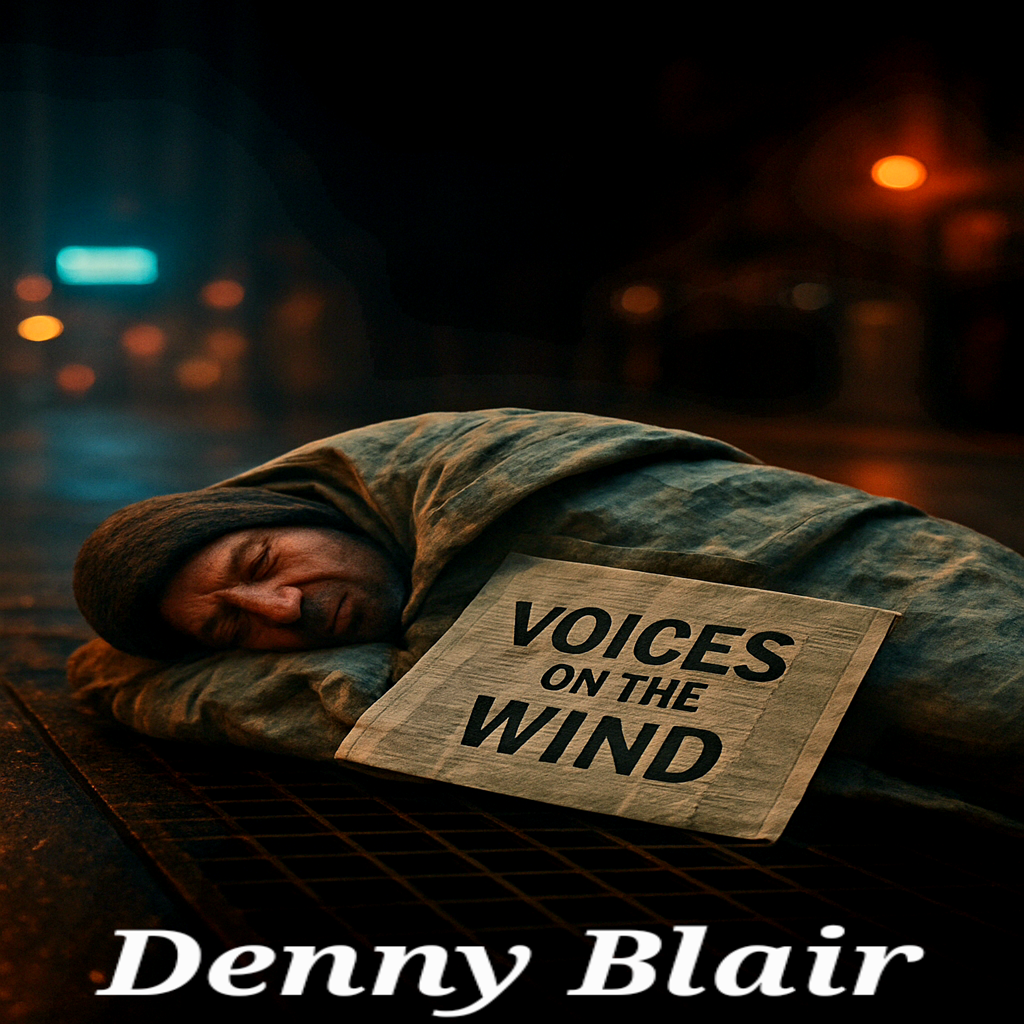
What was the inspiration behind the cover artwork for “Voices On The Wind?”
The inspiration behind the cover artwork for “Voices On The Wind” came from the same place as the song itself — visibility and being unheard. One version of the cover shows a homeless person lying on the ground, wrapped in a newspaper. That image represents how society often treats the homeless: something people read about briefly, step over, and then forget. The newspaper also symbolizes how their stories are reduced to headlines instead of being truly understood as human lives.
The second cover is much more minimal — just a piece of paper with the words, “Voices On The Wind,” being carried away by the air. That paper represents the voices of the homeless themselves. It’s meant to show how their cries for help aren’t anchored anywhere, how they’re ignored and blown away without being acknowledged by those in power. Both covers reflect the same message in different ways: people who exist all around us, yet remain unseen and unheard.
What was the creative process like when making “Voices On The Wind?”
The creative process behind “Voices On The Wind” was very intentional. I wasn’t trying to write something safe or universally liked — I wanted to create something that actually mattered. From the beginning, the focus was on the human side of it, on awareness and connection. I kept thinking about how easy it is for people to disconnect from each other, even though, at the core, we’re all linked in some way.
I knew not everyone would be comfortable with the subject or even agree with the message, but that was never the point. The point was to contribute something meaningful to the broader human consciousness — to remind people that we’re not as separate as we think. Whether we realize it or not, we’re all family, all sharing the same space and the same struggles in different forms. That mindset guided every part of the song, from the lyrics to the atmosphere, and it shaped Voices on the Wind into something more than just a track — it became a statement.
How long did it take to complete “Voices On The Wind?”
The writing process for Voices on the Wind actually came together pretty quickly. I was thinking a lot about my time in Philadelphia, and once I tapped into that headspace, the song started to flow naturally. The words came without much effort, almost like they were already there waiting to be written. From start to finish, the writing itself took about two weeks.
After that, the real work began — bringing the song to life in the studio. I spent time shaping the sound, dialing in the atmosphere, and making sure it carried the emotion and message I wanted people to feel when they heard it. I wanted it to resonate, to make listeners stop and really connect with it. Altogether, from writing to recording and finalizing the track, it took about a month to fully complete.
What is your favorite lyric in “Voices On The Wind” and why?
“I don’t need no prophets in suits and ties
To tell me what’s wrong, to sell me their lies.”
That lyric really says it all for me, because I’ve spent time inside religious institutions, and what I witnessed didn’t always match the message they preached. I saw a lot of hypocrisy — people speaking in the name of love, faith, and morality, while judging, excluding, or outright turning their backs on others. It was hard to reconcile the words with the actions.
When I say, “I don’t need no prophets in suits and ties / To tell me what’s wrong, to sell me their lies,” I’m not rejecting spirituality — I’m rejecting the performance of it. I’m calling out the way belief can be weaponized, monetized, or used to control instead of heal. That lyric stands out to me because it comes from lived experience, not theory. It reflects a deep frustration with institutions that claim moral authority while failing to show basic human compassion.
That’s why it’s one of my favorite lines in the song. It’s honest, it’s uncomfortable, and it speaks for people who’ve been hurt, silenced, or made to feel small by systems that were supposed to uplift them. It’s me choosing truth over polish, humanity over hierarchy.
What message or messages do you hope fans take away from “Voices On The Wind” and your music in general?
The message I hope people take away from “Voices On The Wind,” and from my music in general, is awareness and empathy. I want listeners to slow down and really see each other — especially the people society tends to overlook or ignore. If my music does anything, I hope it reminds people that every life has value and that no one is disposable.
I also hope it encourages people to think for themselves and question the systems, narratives, and institutions that tell us who matters and who doesn’t. At the end of the day, we’re all connected, whether we realize it or not. We’re all sharing this human experience, and we all carry struggles that aren’t always visible. If someone walks away feeling more open, more compassionate, or more willing to stand up for others, then the music has done what it was meant to do.
What’s next for you? Are you working on any upcoming projects, or do you have any upcoming shows that we should be on the lookout for?
Right now, my main focus is finishing and releasing the album that I’ve been working so hard on. This whole project originally started as a way for me to cope with the loss of my father, and it gradually turned into something much bigger and more meaningful than I ever expected. I’ve been putting a lot of time and energy into shaping the album and making sure it reflects where I’m at both creatively and personally.
At the moment, I don’t have any shows or dates lined up yet. Once the album is out, I’m hoping to start getting some live shows under my belt — starting small, feeling things out, and building from there. The goal is to grow naturally, connect with people in real spaces, and eventually work toward bigger venues as the music finds its audience. For now, it’s all about the work and letting the project become what it’s meant to be.
Where can we follow you on social media?
You can follow me and stay up to date with my music and creative journey on social media — I’m active across all the main platforms. Here are my official profiles:
📘 Facebook: [https://www.facebook.com/share/16axTfksAx/]
📸 Instagram:
[https://www.instagram.com/the_kaleidoscope_life1111]
🎥 YouTube:
[https://youtube.com/channel/UCePAAV9RYg_eP7S9DMFP5Vw]
🎵 TikTok:
[https://www.tiktok.com/@theparawarrior]
🐦 Twitter: [https://x.com/PettyDenny24]
Website: dennyblairmusic.weebly.com
I post updates, new music announcements, and more, so be sure
to follow along and connect with me there!
Thank you for the great interview; wish you much continued success!