
Chris Oledude (Chris Owens) is a Puerto Rican-born African American and New York-based artist with a songwriter’s lifelong dedication to truth-telling. Part of a creative family, Chris Oledude grew up harmonizing with his two brothers in a household where classical, folk, pop, funk, and protest music all had a place. His mother, the late Ethel Werfel Owens, was his first music teacher, and his father, the late Major R. Owens, was a librarian-turned-elected official.
In the 1980s, Chris Oledude performed on the streets of New York City, in dance bands, and with his brother Geoffrey Owens (yes, that Geoffrey Owens). His only album-length cassette, 1984’s Anyone’s Revolution, voiced frustration with the Reagan era and caught the attention of family friend and folk icon Pete Seeger, who encouraged Chris Oledude to continue writing songs promoting peace and social justice and to collaborate with like-minded artists. Chris Oledude joined the People’s Music Network for Songs of Freedom and Struggle. Over the next 35 years; however, Chris Oledude was more involved with civic and political activism than “cultural work.”
The death of Chris Oledude’s father stimulated Chris Oledude to form a band with his brothers to perform again. But it was the death of his wife, Sandra Dixon, that led Chris Oledude to re-examine his life and reconnect with music in a new way. In 2020, reborn as “Chris Oledude,” he re-emerged in the digital age with a renewed mission: to blend “old school” genres – particularly pop, funk, and R&B – with the urgency of these times.
Chris Oledude’s song-video tribute, titled “George Floyd: Say Their Names” (Alyssa Dann, Director), earned more than 150 film festival accolades around the world. Looking ahead to his first album, Chris Oledude continued to develop songs, including “Orange Blues 24.” Originally recorded in 2020, “OB24” is a blistering blues jam. The stop-motion video, crafted by creator/director Alyssa Dann over the course of a year with 2,000 photographs, has also earned numerous awards from film festivals. Chris Oledude’s early 2025 release, “No Crowns For Clowns,” is a powerful critique of the political environment and is also accompanied by a video.
Now, the singles, “Turning Tables,” “Rainbow Soul,” and, most importantly, “We Will Get Through This,” are turning everyone’s heads!
With the release of his debut album, PREACHER MAN – VOL. 1, Chris Oledude brings rhythm, roots, and righteous storytelling to the airwaves through a set of songs from multiple decades.
With “We Will Get Through This” out now, we took some time to hear from Chris Oledude. Read below to learn more about Chris Oledude, the story behind “We Will Get Through This,” and what’s to come.
Hi Chris Oledude! Let’s start with how did you get your artist name?
My given name is Christopher Owens. I was named after Christopher Plummer, the actor most known for his portrayal of Captain Von Trapp in the movie version of The Sound of Music. Of course, my parents had seen Plummer in action years earlier, since I was born before The Sound of Music was made, and they resolved their dispute around naming the first-born child through a unanimous agreement that Christopher was the choice.
I love my name. The short version was, of course, “Chris Owens.” HOWEVER, through the years, it became clear to me that there were too many other Chris Owenses in the world – a star basketball player, at least one actor, and a world-famous burlesque performer in New Orleans, to name a few.
When I made the decision in 2020 to focus on developing myself as a musical artist, I needed a change. Personally, I was dealing with the loss of my wife to cervical cancer, an impending retirement from the “regular job” routine, my boys being in college, and my own uncertainty. In addition, I was aware that having a unique brand identity is never a bad thing, and I was not enamored of the idea that the average Google search of “Chris Owens” would result in so many “diverse” personalities.
Being over the age of 60 and starting fresh again with music, I also noted how many artists were using the word “young” in their artist names. I did not see myself as a hip-hop competitor of these folks, but it sounded fun to me to flip the script and champion the “old.” Using “Old Dude,” however, was a bit clumsy to say, required a space, and actually sounded corny. So, I went with the vernacularistic (no such word) contraction, “Oledude.”
Potential confusion regarding the pronunciation of my new name was intriguing to me. I did a search on the name “Chris Oledude” and found that, at least through Google, the only Chris Oledudes out there lived wither in Norway (“OHL-Dude?”) or Nigeria (“O-Le-DOO-Day” or “O-Le-Doo-DAY?”). I was happy that the entertainment world had yet to meet ME, and took on “Chris Oledude” as my artist name – and I have trademarked it and used (be warned)!!!
What city are you from, and where are you based now?
I was born in San Juan, Puerto Rico, USA while my mother was teaching at the University there. I grew up in Brooklyn, NY, where my heart will always be, and I currently reside in Manhattan.
At what point in your life did you decide to pursue a career in music? How did you get started?
I have always wanted to be in music. If I had my way, and if my parents had been better connected to the realities of the music world, I would have been a performer starting in childhood. I always had the talent, but, despite the fact that my mother was my piano teacher and made my brothers and me take lessons on other musical instruments, my parents never advocated for music as a career. They wanted their sons to have solid careers that would keep us economically stable. For me, becoming a lawyer was almost an assumption from birth – so I started believing that is what I was really supposed to do.
I started learning the soprano recorder at the age of six (real lessons), the piano around the same time (from Mom), cello at the age of nine (in public school), conga drums at the age of 10 (Olatunji’s school in Harlem), and clarinet as the age of 12 (public school). I focused more on cello for my classical music (playing in the NY All-City High School orchestra), and, starting in middle school, focused on Elton John for my piano work!
I always sang. I was in school choruses from 4th Grade through early high school and then again during two years in college (Harvard Glee Club, KUUMBA Singers). I was raised on folk and classical music by my mother, but my transistor radio was tuned to 70s rock and old-school R&B stations. In college, I really broadened my listening due to roommates with extensive record collections (vinyl, folks!) and blew my mind with everything from The Crusaders to Jethro Tull to Parliament Funkadelic to ELP.
My first attempt at my own “band” was in elementary school. It was sad, but we had fun singing Jackson 5 songs and one original song of mine (“Black Men With Pride”). I was part of a high school rock band called SWEETFIRE. We were actually pretty good at covering classic songs from Bad Company, Allman Brothers and songs by The Band. We only did one live concert, however, because everyone was heading off to college.
In college, I was part of a very cool and funky R&B band, RHYTHM COMPANY. We had a drummer and one bassist who went on to go pro with their own band, another bassist who became a preacher, an amazing guitarist who was the first Berkley School of Music student I ever knew, a sax player who has become a leader in original avant-garde jazz, I was on keys and vocals, and two other vocalists who were simply outstanding (neither is “singing for a living” at this time, but both still sing.) Our repertoire moved from AWB to EW&F to The Jacksons to The Police (funkiest version of “Voices Inside My Head” you could ever have heard), and one of my first real original tunes – a rap/blues song, “My Street,” inspired by Gil Scott-Heron’s work.
After I finished college, I performed solo for awhile in the early ’80s, but then put together a band in the mid-to-late 80s that doubled as an originals band with one name, MIDNIGHT LANDING, and as a cover band with another name, LUSH LIFE. I met my wife at a wedding where I was both Best Man and bandleader!
How would you describe your sound to readers who may not be familiar with you?
Oledude music is a mix of styles that often focus on social justice-related themes. What you will find on my debut album, PREACHER MAN – VOL. 1 [https://www.oledude.rocks/preacher-man-vol-1], fits this description. Eleven songs spanning 58 minutes of differing flavors. My focus is on being rhythmic – that was not always a priority in my music, but it is now. I believe people have to move if we are going to build the movements that are needed today.
Do you have any hobbies outside of music? What do you do to stay creative?
There are too few hours in the day, unfortunately. And, as many will tell you, you are more busy when you are “retired” than you ever were. Why? Because you’re doing what you really love to do. I watch too much TV, actually, but that is more of an escape. Outside of music, in the formal sense, I like to work with organizations involved with the arts. Here in NYC, I have been active with two of those: Peoples’ Voice Café [peoplesvoicecafe.org] and the People’s Music Network for Songs of Freedom and Struggle [peoplesmusic.org]. Check them out!
Who are some of your main musical influences?
Ludwig van Beethoven, Johann Sebastian Bach, Pete Seeger, Paul Robeson, The Beatles, Stevie Wonder, PRINCE, Smokey Robinson, Led Zeppelin, Jethro Tull, Pink Floyd, ELP, Kansas, George Clinton, EW&F, Stevie Winwood, etc.
What would be a dream collaboration for you?
I would love to co-write one song with Paul McCartney and Elton John…and sing it with them, while adding Billy Joel with a piano solo and Jimmy Page with guitar parts (riff and solo), and then write and perform a song with Stevie Wonder, George Clinton, Jimmy Jam and Terry Lewis.
What’s one of the proudest moments of your music career so far?
In July of 2014, my two brothers and I performed with some friends as OBB – OWENS BROTHERS BAND, at three memorial concerts for Pete and Toshi Seeger held in Manhattan, the Bronx and Poughkeepsie (all New York State). The concert series was called SEEGERFEST. There were some 8,000 people in attendance at the Manhattan concert held outdoors in Lincoln Center. The line-up included Judy Collins, Harry Belafonte, Holly Near, David Amram and many others. That was a blast. Pete was a family friend, so we were quite proud to be there for Pete’s family and to honor his memory. We sang a medley of “Oh, Freedom” and “Amazing Grace.”
What would you say are the greatest lessons that you’ve learned so far?
If we’re talking about music, the lessons are (1) love music, (2) know your craft, (3) be prepared, in order to optimize opportunities – including business, (4) love yourself and your potential listeners enough to keep going.
Now onto your release, “We Will Get Through This.” What inspired this song? What is “We Will Get Through This” about?
The song is an expression of caring for another person – maybe romantic love, but not necessarily. We all have those moments when we need, as Bill Withers wrote, “someone to lean on.” I had worked for a very small non-profit organization, the Philipstown Behavioral Health Hub, that is focused on mental health and substance abuse issues. I really appreciated the mission and the daily work of a tiny and dedicated staff. Having experienced some challenges in my own life and the lives of people close to me, I found myself moving towards writing a song. When I finished it, my first live performance was at a Hub-sponsored event for International Overdose Awareness Day (August 31st).
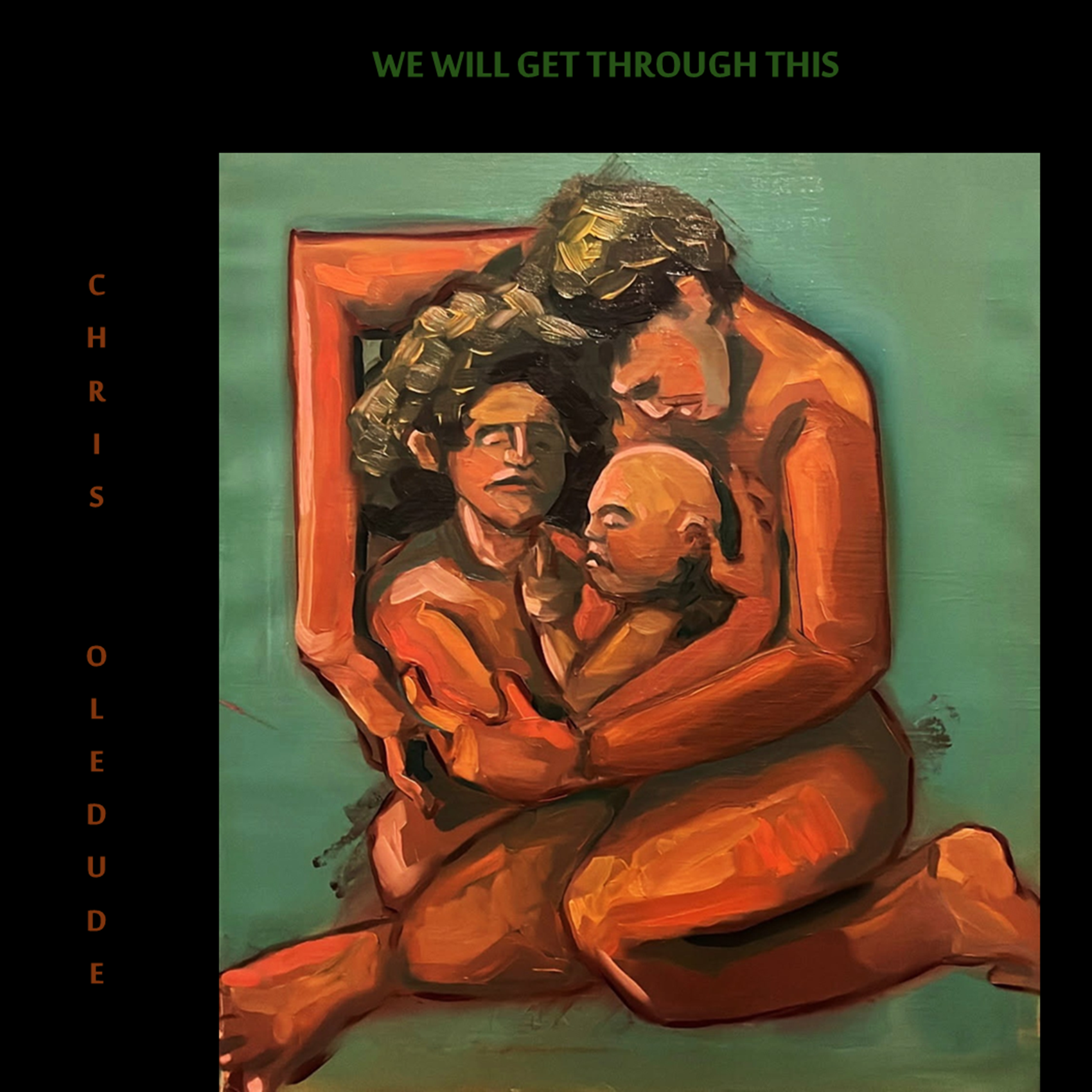
What was the inspiration behind the cover artwork for “We Will Get Through This?”
My nephew, Jordyn Owens, is an incredibly talented artist, as well as an incredibly talented actor and basketball player!!! He stars in a new indie film entitled THE NEXT SHIFT, directed by Adio Ash. I am very proud of him. Check it out!
I have admired Jordyn’s art for years and I asked him if there was anything that he could do with the song, “We Will Get Through This.” He came up with this work, a painting, which I believe may become an even larger-size work. I just could not take my eyes of this piece; I love it!
All the dynamics of familial love explode from this work. Coming at a time when the Trump Administration is using ICE as a weapon of terroristic destruction in our communities, this painting hit me as the perfect portrayal of both fear and safety that I am trying to convey in the song. Again, I just love it!
Jordyn painted the art for my song, “Rainbow Soul,” and he’s working on more pieces for me! And, for the record, he’s a professional and I pay him! 😊
How did the collaboration with Yanitza Lee come about?
Yanitza was first referred to me by a fellow musician in 2023 as I was preparing a concert of my music in celebration of Dr. Martin Luther King, Jr.’s birthday at the Peoples’ Voice Café. While music is not her “job,” Yanitza is classically trained and sings some opera.
I loved the purity of Yanitza’s voice and told her then that we would work together again someday. Fast forward to summer of 2025 and I am plowing through my song arrangements for PREACHER MAN – VOL. 1. I was suddenly inspired to make “We Will Get Through This” a duet, and I knew instantly that Yanitza was THE right person to be the co-lead vocal on this song.
This song is not easy to sing – as I found out – due to the breath control needed to stay in tune while being expressive. The lead vocals are not “belting” for most of the song, it’s a much more mellow role than many R&B or even Pop ballads.
Yanitza also sang background vocals on other tracks!
What was the creative process like when making “We Will Get Through This?”
Writing a ballad is as easy or difficult as any other song – or so I thought. I have written ballads before over the course of 40 years. This one, however, was harder because I was trying to minimize the level of romance or sexual tension being communicated between the two lead singers.
As a result, despite the seeming simplicity of the task, these lyrics were a bit of a challenge and took me a few months to write. Musically, the challenge is always building a chorus that is memorable lyrically AND catches the ear of everyone who hears it. That actually took less time than the lyrics and once I heard it once, I knew it worked.
Finally, I had to build in the studio the sound that I heard in my head. Yanitza was the easy choice as the lead vocalist. A collection of my friends recorded the background vocals and we had a great time mixing it all together. To me, the end result is sometimes overwhelmingly beautiful – and I think that many people are hearing this song and positively responding as well.
How long did it take to complete “We Will Get Through This?”
I was working on an 11-song album. When you add up all of the hours spent on recording and mixing, I think that “We Will Get Through This” took about 50 hours of work. That was more time and money than I expected, but I was being a perfectionist, and I think the result was worth the investment.
What is your favorite lyric in “We Will Get Through This” and why?
The concept reflected in the line, “We are loved and we matter, even when we are shattered” is my favorite concept and lyric. I borrowed the first phrase directly from the Philipstown Hub’s outreach materials because it hit me hard.
What message or messages do you hope fans take away from “We Will Get Through This” and your music in general?
Be a friend and love your friends. It is not easy or convenient – and may not always be possible – but committing to love someone in any way possible is a great thing.
What’s next for you? Are you working on any upcoming projects, or do you have any upcoming shows that we should be on the lookout for?
I have one live performance coming up on Monday, February 23rd in Harlem. Check my website and social media for details. I am also promoting a previously released song during Black History Month. It’s entitled “White Lie: Carolyn’s Story” and is built around the 1955 murder of Emmett Till in Mississippi. In March, I will be releasing the next single from my album, “If A Woman Had Made The World,” featuring the incredible Kiena Williams as my duet partner. I must say that I enjoy sharing a song with other lead singers. It’s part of my appreciation of the “group thing.” For me, music is always a “big sound” experience, even when the volume is low. Thus my choice of favorite creators such as Beethoven, Led Zeppelin and EW&F.
Where can we follow you on social media?
You can find me on Facebook, Instagram, YouTube and TikTok, though I am still learning how to make TikTok really work for me.
On Facebook, look for https://www.facebook.com/ChrisOledude/. On IG, check out https://www.instagram.com/oledude.world/. I hope you enjoy my playlist on my ARTivistUS YouTube channel: https://www.youtube.com/playlist?list=PLJ7SgMK9b9DPvDm0lJtEAFtm8RmJO9M0M. And, you can help me grow on TikTok at https://www.tiktok.com/@chrisoledude.
Thank you for the great interview; wish you much continued success!