
Garbage Garden is an AI-assisted music project based in Kobe, Japan. Born in Busan, South Korea, the artist behind the project spent nearly two decades working as a game designer and professional game translator before discovering SUNO in 2025. Drawing from personal observations of Japan’s Lost Generation and a lifelong fascination with contrasting sounds, Garbage Garden crafts cinematic soundscapes that blend Alternative Metalcore with psychedelic digital textures. The project’s core philosophy—transforming the “garbage” discarded by rigid systems into a vibrant, self-sustaining “garden”—began with the track of the same name and continues through the ongoing “Not to be Lost” series. With a raw and introspective voice, Garbage Garden explores themes of displacement, reclaimed identity, and quiet resistance.
With “busy. being. Real” out now, we took some time to hear from Garbage Garden. Read below to learn more about Garbage Garden, the story behind “busy. being. Real,” and what’s to come.
Hi Garbage Garden! Let’s start with how did you get your artist name?
The name actually comes from a track I released last December titled “Garbage Garden.” That song served as the philosophical starting point for my entire project.
The concept is about finding freedom the moment a rigid, efficiency-driven system deems you “valueless” and throws you out. To the system, you might be “garbage”—something that doesn’t fit their metrics or can’t be “invoiced.” But in that discarded space, away from social pressure and judgment, I found a sanctuary.
I see it as building a vibrant, self-sustaining “Garden” within the “Garbage” or the “void” that society ignores. It’s about reclaiming your own territory and identity in the place where the world thinks nothing of value exists.
What city are you from, and where are you based now?
I was born in Busan, South Korea, a beautiful coastal city. I moved to Seoul during my elementary school years and lived there until I reached adulthood. For the past decade, however, I’ve been living and creating in Kobe, Japan, which is where I am currently based.
At what point in your life did you decide to pursue a career in music? How did you get started?
If I’m being completely honest, the real turning point came when I discovered SUNO—the AI music generation system. I know it’s a subject of much debate lately, but I’ve never felt the need to hide it.
It all started on August 1, 2025. At the time, I had no idea I’d be doing what I am today. Having worked as a game designer and now as a professional game translator for nearly 20 years, I initially stepped into SUNO purely out of technical curiosity.
However, while exploring the platform, I realized that I had so much “dormant content” buried inside me. What started as making tracks just for fun gradually evolved into a space where I could finally tell the stories I had kept hidden for so long. That process of unearthing those buried narratives is what eventually led me to where I am now.
How would you describe your sound to readers who may not be familiar with you?
I’d describe my sound as a blend of Alternative Metalcore and psychedelic digital textures. I enjoy creating cinematic, immersive soundscapes that draw the listener in from the very first note.
While the surface often feels vibrant or even “game-like” due to my background in game design, there’s always an underlying weight to the themes. I like to call it “sad but not mournful”—it’s a sound that holds space for pain and displacement without being consumed by them. It’s music that aims to be a “high-definition frame” for the listener’s own emotions.
Do you have any hobbies outside of music? What do you do to stay creative?
To be honest, I’m not a very active person, so I don’t usually engage in outdoor activities. Since my main profession is game translation, I spend most of my time at home.
It’s actually hard to pinpoint exactly how I stay creative, but I believe constantly processing and translating vast amounts of text keeps my brain in a perpetual creative state. The linguistic labor of finding the right nuance is, in itself, a form of mental exercise.
Beyond that, I spend a lot of time listening to music within the communities I belong to. I don’t just listen for pleasure; I analyze the tracks. It’s fascinating because, even with “AI-assisted music,” each creator’s individuality and sonic preferences come through so strongly. There is so much to learn just by observing those diverse styles, and I suppose you could say that this analytical listening has become my main hobby and source of inspiration.
Who are some of your main musical influences?
It’s hard to pick just a few names because I’ve listened across so many genres without any bias. But if I had to name one artist who shaped my approach to contrasting sounds—choosing a sonic palette that might seem “at odds” with the lyrics—it would be Seo Taiji, a legendary South Korean artist I was obsessed with in middle school. His ability to blend heavy themes with unexpected musical forms left a lasting impression on me.
Beyond that, my most direct influences for my current sound and genre come from my fellow creators within the AI music community. As I mentioned, I spend a lot of time analyzing their tracks, learning from their unique styles, and applying those insights to my own work. In terms of my current sonic direction, I consider my peers to be my greatest influences.
Who would be a dream to collaborate with?
Recently, SUNO established a partnership with Warner Music Group. If the legendary artists from Warner’s roster join the platform, having the opportunity to collaborate with them in various forms would truly be a dream come true.
At the same time, it would be incredibly exciting to officially collaborate with ☆Taku Takahashi or Gay Cat Park, who have both provided me with such profound inspiration and guidance. Of course, it’s all a “dream” for now—but that’s what makes it a beautiful goal to work toward.
What’s one of the proudest moments of your music career so far?
It was when I encountered a music webzine from Brazil that reviewed my work without any bias, despite my being open about the fact that I create “AI-assisted music.” In their review of “busy. being. Real.”, they wrote:
“In ‘busy. being. Real.’, the Garbage Garden project presents a conceptual work that transcends the label of music created by artificial intelligence to reach an essentially human territory.”
To be honest, I’m still at a stage where I’m hesitant to even call myself an “artist,” and I’m still reflecting on that very title. However, receiving that kind of “recognition” from them was a truly proud moment for me.
What would you say are the greatest lessons that you’ve learned so far?
One of the most valuable lessons came from a SUNO remix contest featuring a track by ☆Taku Takahashi of m-flo.
I wasn’t planning to participate at first. But when I saw his comments on Instagram and X about AI in music—“Tools themselves aren’t creative. Creativity comes from how humans use them”—it really resonated with me. That perspective gave me the courage to join the contest.
I’ve also had meaningful conversations with the Italian musician Gay Cat Park on SUNO. He emphasized that no matter what tools we use, what truly matters is the human “spark.” These experiences taught me that the value of music ultimately lies in the creator’s intention and emotion, not in the technology itself. That realization has become my guiding principle.
Now onto your release, “busy. being. Real.” What inspired this song? What is “busy. being. Real” about?
The inspiration for this song is deeply rooted in my personal observations of Japan’s “Lost Generation.” My partner belongs to this generation, and for over 20 years, I have witnessed their lives up close—not as a social statistic, but as an individual reality.
I wanted to capture the sense of “loss” and “displacement” that this generation felt, but I also realized that this exhaustion is no longer exclusive to Japan. For instance, the line “a 24-hour subscription” was inspired by a famous 1990s Japanese energy drink ad that asked, “Can you fight for 24 hours?” To me, that aggressive productivity of the past feels eerily similar to the “subscription-like” exhaustion we all feel in today’s global life.
“busy. being. Real.” is about reclaiming one’s existence from a system that treats efficiency as a religion. The world expects you to be productive 24/7, and stepping off that conveyor belt might look like “failing.” But this song flips that script. I am not idle; I am incredibly busy—not with fulfilling external tasks, but with the exhausting work of unlearning a pre-determined gravity and building my own sanity from scratch. It’s an act of reclaiming the “void” as my own territory.
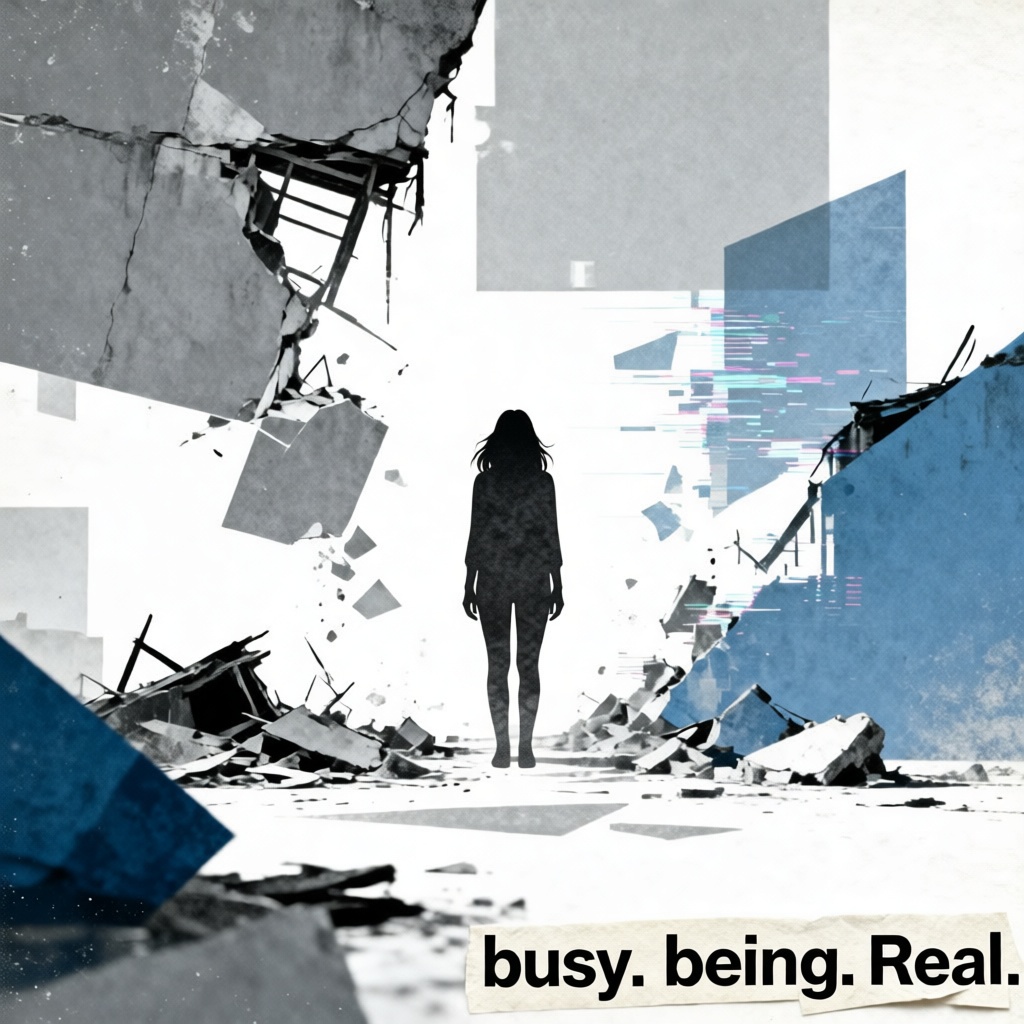
What was the inspiration behind the cover artwork for “busy. being. Real?”
The main inspiration for the artwork was the “Collapse of the Japanese Asset Price Bubble.” It represents a desperate situation where the “shelter” you believed was safe crumbles, leaving you “alone” to endure everything on your own responsibility.
However, I wanted to express the idea that this moment could also be the first step toward true freedom. I used contrasting colors, such as blue, to convey that sense of liberation amidst the ruins. It captures the tension between the despair of losing a system and the birth of a new, independent sanity.
What was the creative process like when making “busy. being. Real?”
The story of the “Lost Generation” had been lingering in my mind for a long time. My partner belongs to that generation, and naturally, my social circle became filled with people of the same age. You could say that nearly 20 years of observation and interest served as the preparation phase for this track.
My process usually starts with the lyrics. I first created a draft of the organized images in my mind and slowly refined them into words. As I write, I already begin to envision the corresponding soundscapes. For this project, I took a very deliberate directorial approach to ensure specific lines—like “I am not lost, they lost me” and the closing “busy. being. Real.”—were reflected exactly as I imagined them in the final production.
How long did it take to complete “busy. being. Real?”
On the surface, the technical generation process was quick. But the real work took about 20 hours of intense focus—constantly refining the lyrics, adjusting the soundscapes, and making sure every element matched the vision I had in my head. Even after that, I listened to the track over 300 times from a pure listener’s perspective to make final tweaks.
In a deeper sense, though, this song took 20 years to create. It grew out of two decades of closely observing Japan’s Lost Generation through my partner and our shared social circle, reading countless books and articles, and experiencing different realities while living abroad in my 20s and 30s. All of that observation was distilled into those 20 hours of actual production.
What is your favorite lyric in “busy. being. Real” and why?
My favorite line is: “I am not lost, they lost me.”
As I mentioned, I go through a process of refining my initial drafts into final lyrics, but there were two lines that remained untouched from the very beginning. This was one of them.
The reason I cherish this line is twofold. Narratively, it marks the pivotal moment where the perspective flips—it’s the emotional climax of the track. But more importantly, it reflects the actual trajectory of many lives within the “Lost Generation.”
In Japan, we are witnessing a tragicomedy where the state practically abandoned an entire generation, leaving them in a state of neglect, only to frantically “search” for them now that they are needed. From that viewpoint, the expression is incredibly apt. It’s not that these individuals wandered off and got lost; it’s that the system, the society, and the nation lost them.
What do you hope fans take away from “busy. being. Real” and your music in general?
Basically, I don’t want to tell anyone “how to live” or “what to do.” I don’t believe I have the right or the capacity to do so. My music is simply a mirror. Whatever you feel or see through it was likely something that was already within you—and that might just be your own “Real.”
If there is one thing I hope you remember, it’s this: Your failure to adapt is not a defect, but a testament to your Real identity. In a world that constantly demands you become a functional gear, choosing to remain “unfit” is a form of resistance. I hope my music can be a space where you can face that truth and reclaim your own sanity, even if it’s amidst the ruins of a collapsing system.
What’s next for you? Are you working on any upcoming projects, or do you have any upcoming shows that we should be on the lookout for?
As you might have guessed from my previous answers, the person behind Garbage Garden will likely never step into the spotlight. I consider myself an ordinary person without any particular “external talent.” However, as for the music, I am constantly dreaming up new ideas and creating.
Both “busy. being. Real.” and my previous track “Tabula Яasa” are part of an ongoing series called “Not to be Lost.” This project is dedicated to telling the stories of things that exist right beside us but are often overlooked or forgotten. While I won’t limit myself to this series, I plan to continue developing it. Most recently, I released a track titled “Triptych+1+1,” which reflects on the Great East Japan Earthquake. I will remain a gardener of these sounds, quietly cultivating the stories that need to be heard.
Where can we follow you on social media?
You can follow my creative journey and stay updated on new releases through the following channels:
YouTube: https://www.youtube.com/@GarbageGarden_Official
Instagram: https://www.instagram.com/garbage.garden.sn
X: https://x.com/GarbageMusic_SN
Suno: https://suno.com/@garbagemusic
Thank you for the great interview; wish you much continued success!